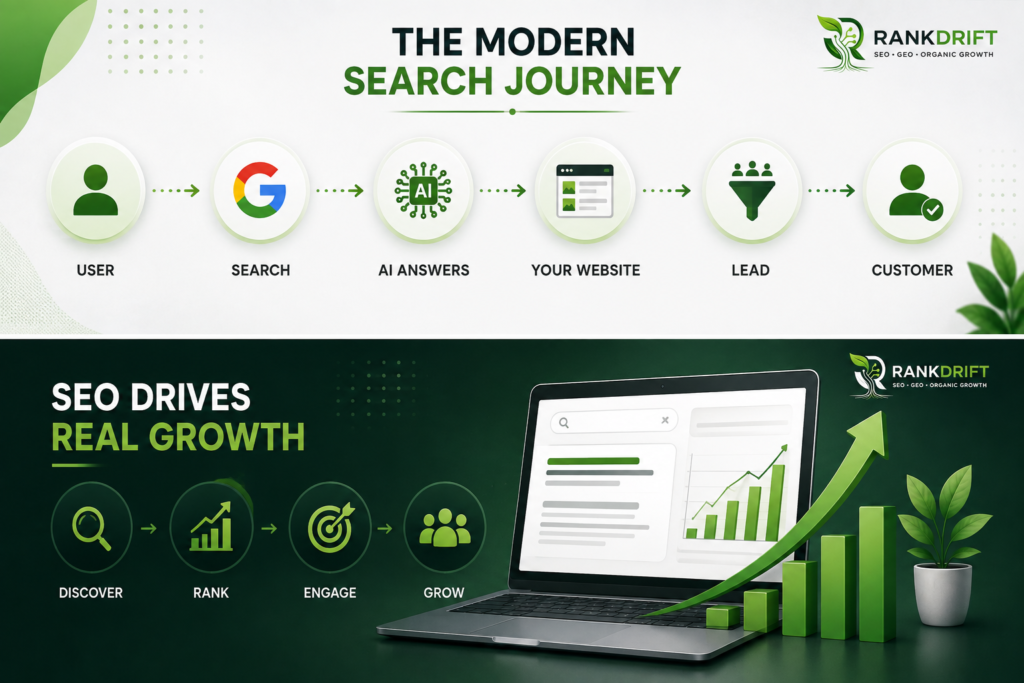
Search behavior has changed faster in the last two years than it did in the previous decade. Google is integrating AI-generated overviews into search, millions of users are asking questions directly to AI assistants like ChatGPT and Gemini, and customers expect instant, trustworthy answers before they ever contact a business.
For businesses in India, this creates a simple reality: if your website isn’t visible where customers search for information, you’re losing opportunities to competitors who are.
Why SEO Matters More Than Ever in 2026
SEO is no longer just about ranking #1 on Google. It has become the foundation of digital visibility across multiple search platforms, including Google Search, AI-powered search experiences, voice assistants, and answer engines.
Several industry developments explain why SEO deserves attention in 2026:
- Google processes billions of searches every day, making organic search one of the largest sources of online discovery. (Source: Google Search documentation)
- Google’s AI Overviews continue expanding globally, changing how users consume information directly from search results. (Source: Google I/O 2024 announcements)
- According to BrightEdge, organic search continues to drive over 50% of trackable website traffic across industries.
These changes mean businesses must optimize not only for traditional rankings but also for AI-driven search experiences.
Practical takeaway: SEO is no longer just a marketing channel—it’s becoming your digital visibility strategy.
How SEO Drives Business Growth
Ranking higher is only part of the story.
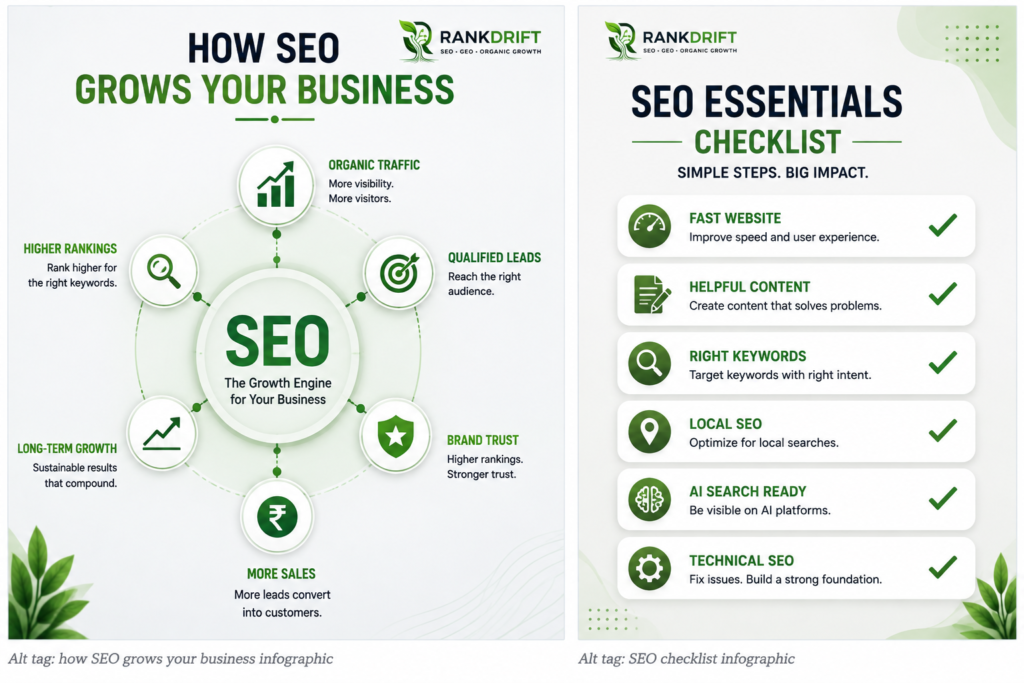
Strong SEO creates a chain reaction that impacts every stage of your customer journey.
1. Your Customers Already Have Buying Intent
Unlike social media advertising, where you interrupt users, SEO reaches people actively searching for solutions.
For example:
- “best CRM software”
- “SEO agency in Delhi”
- “digital marketing company near me”
These users already need help.
That makes search traffic significantly more valuable than random website visitors.
Comparison
| Organic SEO | Paid Advertising |
|---|---|
| Long-term traffic | Stops when budget ends |
| Builds authority | Builds visibility only while spending |
| Lower acquisition cost over time | Rising CPC every year |
| Improves trust | Users often skip ads |
2. SEO Builds Trust Before Sales Conversations
Google’s ranking systems reward websites demonstrating:
- Helpful content
- Experience
- Expertise
- Authority
- Trustworthiness (E-E-A-T)
Businesses that consistently publish useful content earn credibility before prospects even schedule a call.
According to Google Search Quality Evaluator Guidelines, trust is one of the most important evaluation concepts.
When someone repeatedly sees your brand answering questions online, they’re far more likely to choose you over an unknown competitor.
3. SEO Produces Compounding Results
Paid campaigns work like renting attention.
SEO works more like owning digital real estate.
A well-optimized article can generate qualified traffic for years with periodic updates.
Example:
| Month | Paid Ads Traffic | SEO Traffic |
|---|---|---|
| Month 1 | High | Low |
| Month 6 | High (budget dependent) | Growing |
| Month 12 | Stops if ads stop | Continues generating leads |
This compounding effect is why many successful businesses continue investing heavily in SEO.
SEO in 2026 Is More Than Google Rankings
Businesses now need visibility across multiple discovery platforms.
Traditional Search
Google remains the largest traffic source for most industries.
Technical SEO, content quality, backlinks, page speed, and search intent still matter.
AI Search
Users increasingly ask AI tools questions like:
- “Recommend an SEO agency.”
- “Best accounting software for startups.”
- “How much does digital marketing cost?”
These answers often summarize multiple trusted websites.
Businesses with authoritative, well-structured content are more likely to be referenced.
Platforms include:
- ChatGPT
- Google AI Mode
- Gemini
- Perplexity
Local Search
For local businesses, Google Business Profile has become just as important as the website itself.
According to Google, searches containing phrases like “near me” continue to represent strong local purchase intent.
Optimizing for:
- Reviews
- Local citations
- Maps
- Service pages
- Location pages
helps convert nearby customers into paying clients.
What Modern SEO Looks Like
SEO in 2026 combines several disciplines rather than focusing only on keywords.
| SEO Area | Purpose |
|---|---|
| Technical SEO | Crawlability, indexing, Core Web Vitals |
| On-Page SEO | Search intent, headings, internal links |
| Content Strategy | Answer customer questions |
| Local SEO | Map visibility and local leads |
| AI Search Optimization | Structured answers for LLMs |
| Digital PR | Authority through quality mentions |
| Analytics | Measure ROI and conversions |
Businesses succeeding today invest across all these areas rather than chasing shortcuts.
Common SEO Mistakes Businesses Still Make
Despite SEO becoming more sophisticated, many businesses repeat the same mistakes.
Chasing Only Keywords
Ranking for high-volume keywords doesn’t guarantee revenue.
Focus on commercial intent instead.
Example:
Instead of:
Digital marketing
Target:
Digital marketing agency for manufacturing companies
The second keyword attracts far more qualified prospects.
Ignoring Technical SEO
Common issues include:
- Broken pages
- Slow loading speed
- Duplicate content
- Missing schema
- Poor mobile experience
Google has repeatedly emphasized page experience and usability as ranking considerations.
Publishing Generic AI Content
AI writing tools can speed up content creation.
They cannot replace:
- Industry expertise
- Original examples
- Real customer insights
- Proprietary data
Google’s guidance focuses on helpful, people-first content, regardless of whether AI assisted in creating it.
Measuring Rankings Instead of Revenue
SEO success should include:
- Leads
- Phone calls
- Demo requests
- Sales
- Revenue
Traffic without conversions is only a vanity metric.
A Practical SEO Growth Framework for 2026
Businesses don’t need hundreds of blog posts.
They need a structured strategy.
Step 1
Audit your current website.
Identify:
- Technical issues
- Indexing problems
- Content gaps
- Slow pages
Step 2
Understand customer search intent.
Group keywords into:
- Informational
- Commercial
- Transactional
Create content for each stage.
Step 3
Optimize your service pages.
Each page should answer:
- What do you offer?
- Who is it for?
- Why choose you?
- What results can customers expect?
Step 4
Build topical authority.
Instead of writing random blogs, cover an entire subject comprehensively.
Example:
SEO
→ Technical SEO
→ Local SEO
→ Ecommerce SEO
→ AI SEO
→ SEO Audit
→ Core Web Vitals
Google better understands expertise when content is organized into topical clusters.
Step 5
Track business metrics.
Monitor:
- Organic traffic
- Qualified leads
- Conversion rate
- Cost per acquisition
- Revenue from organic search
These metrics matter more than rankings alone.
SEO Checklist for Business Owners
Before investing further in digital marketing, ask yourself:
- Is every important page indexed by Google?
- Does your website load quickly on mobile devices?
- Are you targeting customer intent rather than only search volume?
- Is your Google Business Profile fully optimized?
- Are your service pages written to convert visitors?
- Do you publish genuinely helpful content?
- Are you earning quality backlinks naturally?
- Is your website visible in AI-generated search experiences?
- Are conversions tracked in Google Analytics?
- Do you measure SEO using revenue rather than rankings?
If you answered “No” to several questions, your business likely has untapped organic growth opportunities.
Frequently Asked Questions
Is SEO still worth investing in during 2026?
Yes. Organic search continues to generate a significant share of website traffic, and SEO now supports visibility across Google Search, AI search experiences, and local discovery platforms. While tactics evolve, the need for trusted, high-quality content remains consistent.
How long does SEO take to show results?
Most businesses begin seeing measurable improvements within 3–6 months, while competitive industries may require 6–12 months or longer. Results depend on competition, website quality, content, and technical health.
Is SEO better than Google Ads?
Neither replaces the other. Google Ads delivers immediate visibility, while SEO builds sustainable, long-term traffic and brand authority. Many successful businesses use both together.
Can AI replace SEO?
No. AI changes how people search, but it increases the importance of authoritative content, structured information, and trustworthy websites. SEO now includes optimizing for both traditional search engines and AI-powered answer engines.
Should small businesses invest in SEO?
Absolutely. Local SEO, targeted service pages, and helpful content allow small businesses to compete effectively without matching the advertising budgets of larger brands.
The Bottom Line
The businesses that grow in 2026 won’t necessarily be the ones spending the most on advertising they’ll be the ones that are easiest to discover, trust, and choose across Google, AI search platforms, and local search results.
SEO is no longer just about improving rankings. It’s about building lasting digital visibility that keeps generating qualified leads long after individual campaigns end.
At Rank Drift, we help businesses build future-ready SEO strategies that combine technical excellence, content authority, Local SEO, and AI search optimization so your brand is visible wherever your customers are searching next.