
A good SEO strategy is not simply a list of keywords, backlinks, and blog posts. It is a coordinated plan that helps search engines understand your website, gives users the information they need, and turns relevant organic traffic into business results. Google itself says its ranking systems prioritize helpful, reliable, people-first content rather than content created primarily to manipulate rankings.
For businesses in India, this means SEO should be built around search intent, technical health, useful content, authority, local visibility, and measurable conversions not rankings alone.
Why a Good SEO Strategy Matters More Than Individual SEO Tactics
Many businesses approach SEO as a collection of disconnected tasks: add keywords, publish blogs, build backlinks, and wait for rankings. The problem is that individual tactics rarely solve the whole search journey.
Google’s Search Essentials groups SEO into three broad areas: technical requirements, spam policies, and key best practices such as creating helpful content and using the words people search for in important parts of a page.
A strong strategy connects these areas to a business objective.
For example, a service business might want more qualified enquiries rather than simply more website visitors. Its SEO strategy should therefore target searches that indicate commercial intent, create pages that answer those searches, build credibility around the service, and make it easy for visitors to contact the business.
SEO Tactics vs. SEO Strategy
| SEO Tactic | SEO Strategy |
|---|---|
| Add keywords to a page | Understand search intent before creating the page |
| Publish more blogs | Build content around valuable customer questions |
| Get backlinks | Earn relevant authority for important pages |
| Improve rankings | Increase qualified traffic and conversions |
| Fix technical errors | Build a technically accessible website |
| Track keyword positions | Measure visibility, traffic, leads and revenue |
The difference is important: tactics are individual actions; strategy determines which actions deserve your time and why.
1. Start With Business Goals and Search Intent
Before choosing keywords, identify what you actually want SEO to achieve.
A B2B company may want demo requests. An ecommerce business may want product sales. A local business may want calls, directions, bookings, or enquiries. These goals determine the type of searches and pages you should prioritize.
Search intent should then connect those goals to specific queries.
Consider a business selling accounting software. Someone searching “what is accounting software” is probably researching. Someone searching “best accounting software for small business” is comparing options. A search such as “accounting software pricing India” can indicate much stronger commercial intent.
Your content strategy should reflect these differences instead of sending every searcher to the same generic service page.
A Simple Search Intent Framework
| Search Intent | Example Query | Best Page Type | Business Goal |
|---|---|---|---|
| Informational | What is SEO? | Guide / Blog | Awareness |
| Commercial | Best SEO agency in India | Comparison / Service page | Consideration |
| Transactional | Buy accounting software | Product / Landing page | Sales |
| Local | SEO agency near me | Local landing page | Enquiries |
| Navigational | RankDrift SEO services | Brand page | Direct conversion |
Google’s guidance recommends using the words people would use to find your content in prominent locations such as page titles, headings, alt text, and link text.
The key is not to force keywords into every sentence. Instead, build a page that genuinely satisfies the search behind the keyword.
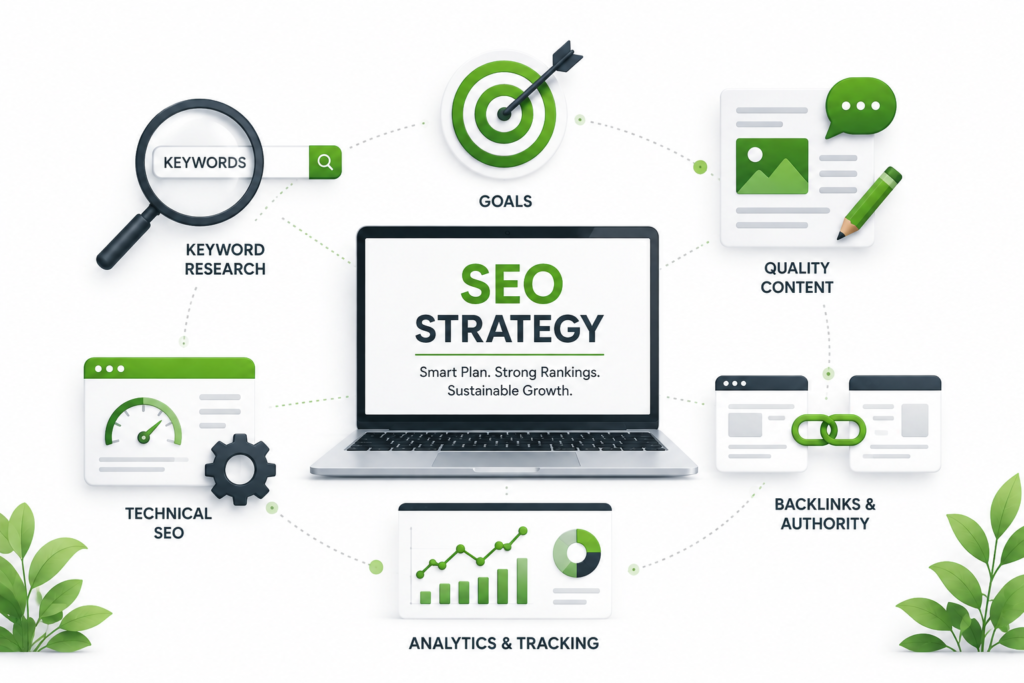
2. Build a Technically Strong Website
Even excellent content can struggle if search engines cannot properly access, crawl, or understand the website.
Google explains that its crawler needs to be able to access the same important resources that users’ browsers can access. If critical CSS or JavaScript is blocked, Google may have difficulty understanding the page.
A technically sound SEO strategy should therefore cover:
- Crawlability and indexability
- XML sitemap
- Robots.txt
- Canonical URLs
- HTTPS
- Mobile usability
- Internal linking
- Page speed
- Structured data where appropriate
- Broken links and redirects
- Duplicate or thin pages
Internal linking deserves particular attention. Google says links help it find new pages and understand the relevance of pages, while descriptive anchor text helps both users and Google understand the destination.
Core Web Vitals Should Also Be Monitored
Google’s current Core Web Vitals guidance identifies three important user-experience metrics:
| Metric | What It Measures | Good Target |
|---|---|---|
| LCP | Loading performance | ≤ 2.5 seconds |
| INP | Responsiveness | < 200 ms |
| CLS | Visual stability | < 0.1 |
These numbers are useful benchmarks, but they should not become the entire SEO strategy. Google explicitly states that achieving good Core Web Vitals does not guarantee top rankings. Page experience works alongside relevance, content quality, and other ranking systems.
That is why chasing a perfect technical score while ignoring weak content is usually the wrong priority.
3. Create Content That Deserves to Rank
Content is where many SEO strategies become repetitive.
Publishing 50 articles that say essentially the same thing will not automatically outperform publishing 10 genuinely useful resources. Google specifically warns against creating large amounts of content primarily to attract search-engine traffic, including mass-produced content that adds little value.
A better strategy is to build topic depth.
Suppose RankDrift wants to build authority around SEO for businesses. Instead of publishing random articles about unrelated marketing subjects, the content ecosystem could cover:
- SEO strategy
- Keyword research
- Technical SEO
- Local SEO
- Link building
- Google Search updates
- SEO measurement
- SEO for startups
- AI search visibility
- SEO case studies
Each article should have a clear purpose and connect naturally to relevant service or supporting pages.
What Makes SEO Content Strong?
Good SEO content should provide:
Original value: Add examples, analysis, experience, data, or processes rather than simply rewriting existing search results.
Clear expertise: Explain who created the content and why the reader should trust the information. Google recommends making authorship and relevant expertise clear where appropriate.
Complete answers: Address the main question while also covering the practical follow-up questions a reader is likely to have.
Useful structure: Use descriptive headings, short paragraphs, tables, examples, and clear next steps.
A reason to exist: The content should be useful even if the reader never visits Google.
Google’s guidance is especially clear on this point: the goal should be people-first content, not search-engine-first content.
4. Build Authority With Relevant Links and Internal Connections
Links still matter, but a good SEO strategy does not treat backlink quantity as the primary objective.
Google’s ranking-systems documentation explains that link analysis systems help Google understand how pages relate to one another, with PageRank remaining part of Google’s broader ranking systems.
For a business website, the priority should therefore be relevance and quality.
A link from a relevant industry publication, business association, specialist website, or credible resource can be more strategically useful than dozens of unrelated links.
Internal links are equally important because they help distribute context across your own website.
For example:
SEO guide → Technical SEO article → Technical SEO service page
This creates a logical path for both users and search engines.
Link Building: Quantity vs. Relevance
| Approach | Short-Term Effort | Strategic Value |
|---|---|---|
| Hundreds of unrelated links | High | Low |
| Paid low-quality links | Medium | Risky |
| Relevant industry mentions | Medium | High |
| Digital PR | High | High |
| Useful original research | High | Very High |
| Strong internal linking | Low | High |
A good strategy focuses on earning links because the content is useful, credible, or newsworthy—not simply because a link exists.
5. Optimize for Local and Modern Search Behavior
For businesses serving specific cities or regions, local SEO should be part of the overall strategy rather than an afterthought.
Your website should clearly communicate:
- Where you operate
- Which services you provide
- Who you serve
- What makes your business credible
- How customers can contact you
Local landing pages should provide genuinely useful local information rather than creating dozens of nearly identical pages with city names swapped.
Google’s ranking systems also use freshness systems for queries where users are likely to expect recent information.
This means your SEO strategy should include a process for reviewing important content when the underlying information changes.
The same principle applies as users increasingly interact with search through AI-generated answers and conversational interfaces: clear, factual, well-structured information gives systems more useful material to understand and reference.
6. Measure SEO Like a Business Channel
A strategy without measurement becomes guesswork.
Do not judge SEO entirely by whether one keyword moved from position 12 to position 8. Rankings can fluctuate, and a ranking improvement means little if it produces no valuable business activity.
Google Search Console provides website owners and SEO professionals with information about how their sites perform in Google Search.
A stronger measurement framework includes:
| SEO Metric | What It Tells You |
|---|---|
| Organic impressions | Search visibility |
| Organic clicks | Search traffic |
| Click-through rate | SERP effectiveness |
| Keyword visibility | Topic performance |
| Landing-page traffic | Page-level demand |
| Leads / enquiries | Business impact |
| Conversion rate | Traffic quality |
| Revenue from organic | Commercial value |
For example, if organic traffic rises 40% but qualified enquiries remain unchanged, the answer may not be “publish more content.” You may need to improve search intent targeting, landing pages, calls to action, or conversion paths.
That is the difference between traffic optimization and business-focused SEO.
Common SEO Strategy Mistakes
Targeting Keywords Without Understanding Intent
A keyword may have significant search volume but still be commercially irrelevant to your business. Always ask what the searcher actually wants before deciding which page should rank.
Publishing Content Just to Increase Website Size
More URLs do not automatically mean more authority. Google’s guidance specifically warns against producing large volumes of content primarily to manipulate search visibility.
Ignoring Technical Problems
If important pages cannot be crawled, indexed, or properly rendered, publishing additional content may not solve the underlying problem.
Chasing Perfect SEO Scores
A technical audit score is a diagnostic tool, not the definition of SEO success. Google states that good Core Web Vitals alone do not guarantee strong rankings.
Measuring Only Rankings
Rankings are useful, but leads, qualified traffic, conversions, and revenue tell you whether SEO is actually helping the business.
A Practical SEO Strategy Checklist
Use this checklist when building or reviewing your SEO plan:
- Define the business goal — leads, sales, bookings, calls, or brand visibility.
- Research your audience — understand the questions and problems customers search for.
- Map search intent — assign the right page type to each important search.
- Audit technical SEO — check crawling, indexing, redirects, speed, mobile usability, and HTTPS.
- Build topic clusters — organize related content around important business topics.
- Improve existing pages — update weak, outdated, or overlapping content before creating unnecessary new pages.
- Strengthen internal links — connect related pages using descriptive anchor text.
- Earn relevant backlinks — focus on useful content, partnerships, PR, research, and industry relevance.
- Optimize local visibility — make location, services, contact information, and business details clear.
- Track conversions — connect organic search performance to actual business outcomes.
- Review performance regularly — use Search Console and analytics to identify opportunities.
- Update the strategy — respond to changes in customer behavior, competition, and search systems.
FAQs About a Good SEO Strategy
What is a good SEO strategy?
A good SEO strategy combines technical SEO, search-intent research, useful content, internal linking, authority building, local optimization where relevant, and performance measurement around clear business goals.
How long does an SEO strategy take to work?
There is no universal timeline. Results depend on competition, website authority, technical condition, content quality, search demand, and the resources invested. SEO should be treated as a sustained growth channel rather than a guaranteed short-term ranking tactic.
Should every business invest in SEO?
SEO can be valuable for businesses whose customers actively research products, services, problems, or brands through search. The business case becomes stronger when organic visibility can generate qualified leads or sales.
Is publishing more blogs the best SEO strategy?
No. More content is useful only when it serves a genuine audience need. Google explicitly recommends people-first content and warns against producing content primarily to manipulate search rankings.
What should businesses measure in SEO?
Track visibility, clicks, landing-page performance, qualified organic traffic, leads, conversions, and revenue alongside keyword rankings. The exact mix should reflect the business’s primary goals.
Final Takeaway
A good SEO strategy is not the one with the most keywords, backlinks, or published articles. It is the one that connects what people search for with what your business can genuinely provide, then supports that connection with a technically accessible website, useful content, credible authority, and measurable conversion paths.
For businesses that want to turn search visibility into sustainable growth, RankDrift can help build an SEO strategy around the areas that actually matter—not vanity metrics.