

A website can have excellent content and strong backlinks yet still struggle in Google Search if search engines cannot properly crawl, understand, or index its pages. Google itself describes Search as a three-stage process: crawling, indexing, and serving results. Technical SEO helps your website move through those stages correctly.
For businesses competing for organic traffic, technical SEO is not just a developer task. It is the infrastructure that allows your content, keywords, pages, and authority actually to contribute to search visibility.
Why Technical SEO Matters More Than Ever
Search engines have become better at understanding content, but that does not remove the need for a technically accessible website. Google still needs to discover URLs, crawl resources, process content, understand page relationships, and decide which versions of pages should be indexed.
This becomes particularly important for modern websites built with JavaScript frameworks, page builders, large plugin stacks, ecommerce systems, and dynamic URLs. A small technical problem can affect hundreds or thousands of pages at once.
Performance is another major consideration. The 2025 Web Almanac analyzed data from more than 16 million websites, giving a large-scale view of how the modern web performs.
Its 2025 data found that only 48% of mobile websites achieved good overall Core Web Vitals, compared with 56% on desktop.
| Technical area | What can go wrong | Business impact |
|---|---|---|
| Crawling | Important pages cannot be discovered | Pages may receive little or no organic visibility |
| Indexing | Pages are excluded or wrong versions are indexed | Valuable content may not appear in Search |
| Speed | Slow loading and heavy resources | Poor user experience and weaker performance |
| Mobile | Desktop and mobile content differ | Search visibility can be affected |
| Canonicals | Duplicate URLs compete | Signals become unclear |
| Internal links | Important pages are isolated | Discovery and authority flow suffer |
| Structured data | Search engines get less context | Some search enhancements may be missed |
Technical SEO is therefore best viewed as search infrastructure rather than a one-time checklist.
Crawling and Indexing: The Foundation of Technical SEO
Before worrying about ranking positions, make sure Google can actually access the pages you want to rank.
Google uses crawlers to discover URLs and download page resources. It then processes that information during indexing. If an important page cannot be crawled or is unintentionally excluded from indexing, strong content optimization cannot compensate for the problem.
Check Your Robots.txt
The robots.txt file tells crawlers which URLs or resources they are allowed to request. It is useful for managing crawling, but it should not be treated as the main method for removing a page from Google’s index.
Google specifically recommends using noindex when the goal is to prevent indexing rather than using robots.txt for that purpose.
A common mistake is accidentally blocking an important folder, resource, or page during a website redesign.
Keep Your XML Sitemap Clean
An XML sitemap gives search engines information about important URLs on your website. It is particularly useful for helping Google discover new and updated pages.
Your sitemap should contain URLs that you actually want indexed. Avoid filling it with redirected, duplicate, broken, or noindex URLs.
For a growing business website, regularly reviewing the sitemap in Google Search Console can reveal indexing problems before they become larger SEO issues.
Use Internal Links Strategically
Internal links help users and search engines move between related pages.
Instead of publishing a new service page and leaving it isolated, connect it from relevant service, location, blog, and category pages. Google recommends crawlable standard links because they help its systems discover pages across a website.
Think of internal linking as a map. Your most commercially important pages should not be buried several clicks deep with no relevant internal links pointing toward them.
Technical SEO and Website Performance
A technically optimized website should not only be crawlable; it should also provide a usable experience.
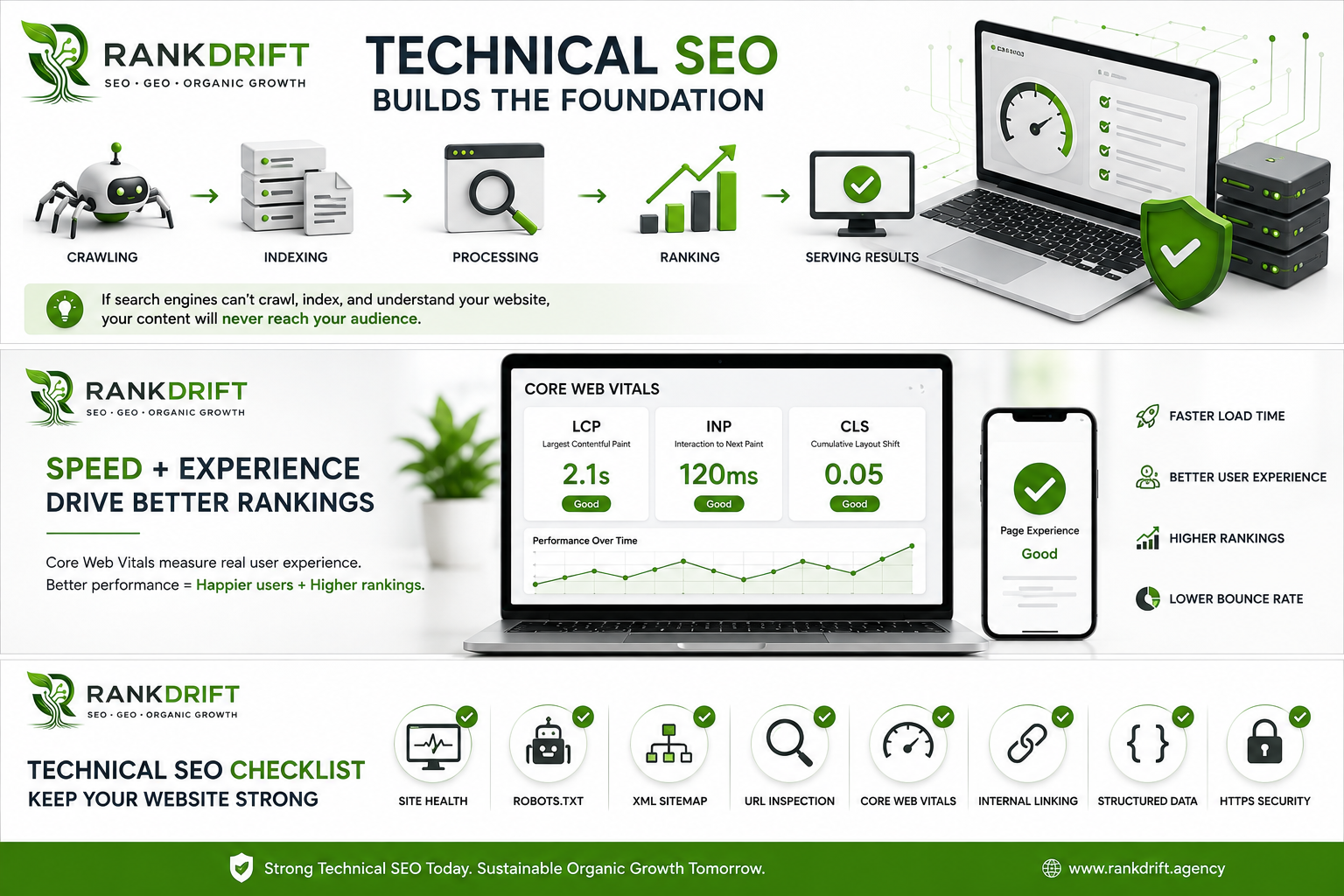
Google’s Core Web Vitals focus on three areas:
- LCP: how quickly the main content becomes visible
- INP: how quickly a page responds to user interactions
- CLS: how stable the layout remains while loading
The current “good” thresholds are 2.5 seconds or less for LCP, 200 milliseconds or less for INP, and 0.1 or less for CLS.
The numbers show why performance deserves attention. In 2025, only 48% of mobile websites achieved good overall Core Web Vitals.
That means performance optimization remains a real competitive opportunity.
Where Performance Problems Usually Come From
For many business websites, the problem is not one massive technical error. It is the combination of several smaller issues:
- Oversized images
- Too many third-party scripts
- Heavy page builders
- Unused CSS and JavaScript
- Poor hosting performance
- Excessive plugins
- Render-blocking resources
- Inefficient caching
- Unoptimized fonts and media
The solution should therefore start with measurement rather than random optimization.
Use tools such as Google Search Console, PageSpeed Insights, Lighthouse, and real-user performance data to identify where users are actually experiencing delays.
The 2025 Web Almanac found that mobile performance continues to lag behind desktop, with only 48% of mobile websites achieving good overall Core Web Vitals.
For Indian businesses, this matters even more when a large portion of customers discover services through smartphones and varying network conditions.
Mobile SEO Is Part of Technical SEO
Google uses the mobile version of a site’s content for indexing and ranking under mobile-first indexing.
That makes mobile optimization more than a design preference.
Your mobile version should contain the important content, structured data, metadata, images, and links that exist on the desktop experience. Google specifically recommends ensuring that important content and markup are available on the mobile version.
A technically sound mobile experience should answer four basic questions:
- Can users read the content without zooming?
- Can they navigate and click buttons easily?
- Does the main content load quickly?
- Does the mobile page contain the same important SEO information?
If the answer is no, the technical SEO audit is not finished.
Canonicals, Redirects and Duplicate URLs
Modern websites frequently create multiple URLs that represent similar or identical content.
For example:
example.com/services
example.com/services/
example.com/services?source=google
Depending on the website setup, these URLs can create unnecessary duplication or competing signals.
Canonical tags help indicate which URL should be treated as the preferred version. Google recommends using canonicalization to help search engines understand duplicate URL groups and select the canonical version.
Redirects are equally important during website migrations, URL changes, and content restructuring.
| Situation | Recommended approach |
|---|---|
| Page permanently moved | 301 redirect |
| Duplicate page | Canonical or consolidation |
| Page should not appear in Search | noindex where appropriate |
| Important page with multiple URL variants | Choose a preferred canonical URL |
| Deleted page with a useful replacement | Redirect to the relevant replacement |
| Deleted page with no replacement | Return an appropriate status rather than redirecting everything to the homepage |
A common misconception is that redirecting every deleted URL to the homepage is good SEO. It usually creates a poor experience and does not provide a meaningful replacement for the original intent.
JavaScript, Structured Data and Modern Websites
JavaScript makes websites more interactive, but it can introduce additional SEO complexity.
Google can process JavaScript, but developers still need to make sure important content, links, metadata, and canonical signals are accessible and correctly implemented. Google provides specific JavaScript SEO guidance because rendering can introduce technical limitations and unexpected behavior.
Structured data is another important technical layer.
It helps search engines understand what a page represents—for example, a product, organization, article, event, or local business. It does not guarantee a rich result, but correctly implemented structured data can make your content easier for search systems to interpret.
For businesses investing in SEO, technical implementation should therefore support both human users and machine understanding.
Common Technical SEO Mistakes Businesses Make
Technical SEO problems often remain hidden because the website looks perfectly normal to a visitor.
Mistake 1: Assuming a Published Page Is Automatically Indexed
Publishing a page does not guarantee that Google will crawl, index, or serve it in search results. Google explicitly states that meeting technical requirements does not guarantee indexing or ranking.
Mistake 2: Blocking Important Pages in Robots.txt
A small robots.txt change during development can prevent crawlers from accessing important sections of a site.
Always review the file after major website updates.
Mistake 3: Ignoring Mobile Performance
A site can look fast on a powerful office laptop while performing poorly on a mobile device.
Real-user data should guide performance decisions rather than relying only on your own browsing experience.
Mistake 4: Treating Core Web Vitals as the Entire SEO Strategy
Good Core Web Vitals are valuable, but they are not a substitute for relevant content, strong information architecture, crawlability, useful internal links, or search intent alignment.
Google itself describes page experience as a broader concept rather than a single ranking signal.
Mistake 5: Making Technical Changes Without Monitoring
Changing URLs, templates, navigation, JavaScript, plugins, or hosting can affect SEO.
Technical SEO should therefore be monitored continuously rather than checked only once a year.
A Practical Technical SEO Checklist
If you manage a business website, start with these steps:
- Check Google Search Console for indexing and crawling issues.
- Review robots.txt and make sure important resources are accessible.
- Check your XML sitemap for valid, indexable URLs.
- Inspect important pages using Google’s URL Inspection tool.
- Review Core Web Vitals for mobile and desktop.
- Test mobile usability across important templates.
- Audit canonical tags on key pages.
- Check redirects after URL changes or redesigns.
- Improve internal linking to important commercial pages.
- Review JavaScript-rendered content to ensure essential information is accessible.
- Validate structured data where relevant.
- Monitor changes after every major technical update.
For a small business website, these checks can prevent problems that would otherwise remain unnoticed for months.
How Technical SEO Supports Business Growth
Technical SEO does not generate revenue by itself. Its job is to remove barriers between your website and the people searching for what you offer.
Consider the difference:
Poor technical foundation:
Google struggles to crawl important pages → fewer pages are indexed → less search visibility → fewer opportunities to attract organic visitors.
Strong technical foundation:
Important pages are accessible → content can be discovered and understood → relevant pages can compete in Search → organic traffic has more room to grow.
This is why technical SEO should be connected to business priorities.
If your highest-value service page is slow, poorly linked, accidentally blocked, or canonicalized incorrectly, fixing that page can be more valuable than spending weeks publishing additional low-priority content.
Technical SEO vs Content SEO
Technical SEO and content SEO should not compete with each other.
| Technical SEO | Content SEO |
|---|---|
| Makes pages accessible | Makes pages useful |
| Improves crawlability | Targets search intent |
| Controls indexing signals | Builds topical relevance |
| Improves site architecture | Answers customer questions |
| Supports performance | Builds organic visibility |
| Fixes technical barriers | Builds authority and trust |
A technically perfect website with weak content will struggle to attract valuable searches.
A website with excellent content but serious technical problems may fail to get that content discovered or indexed properly.
The strongest strategy combines both.
Final Takeaway
Technical SEO is the foundation that allows every other SEO investment to work properly. Before publishing more content or building more backlinks, make sure Google can crawl, understand, index, and efficiently access the pages that matter most to your business.
For businesses working with RankDrift, the goal should not be to chase technical scores for their own sake. The goal is to build a website where technical performance supports visibility, user experience, and sustainable organic growth.
FAQs
What is technical SEO?
Technical SEO is the process of improving the technical structure and performance of a website so search engines can crawl, understand, index, and access its content effectively.
Is technical SEO important for small businesses?
Yes. A small website can still have major technical problems such as incorrect indexing, broken links, slow pages, duplicate URLs, or mobile usability issues. Fixing these can protect the visibility of valuable pages.
Does technical SEO improve Google rankings?
Technical SEO can remove barriers that prevent search engines from properly accessing and understanding a website. However, technical optimization alone does not guarantee rankings because Google evaluates many factors.
How often should technical SEO be checked?
A basic technical review should be ongoing, with deeper audits after website redesigns, migrations, major URL changes, platform changes, or significant performance issues.
What is the first technical SEO check a business should perform?
Start with Google Search Console. Review indexing, crawl issues, Core Web Vitals, sitemap status, and the URL Inspection tool before moving into more advanced technical analysis.