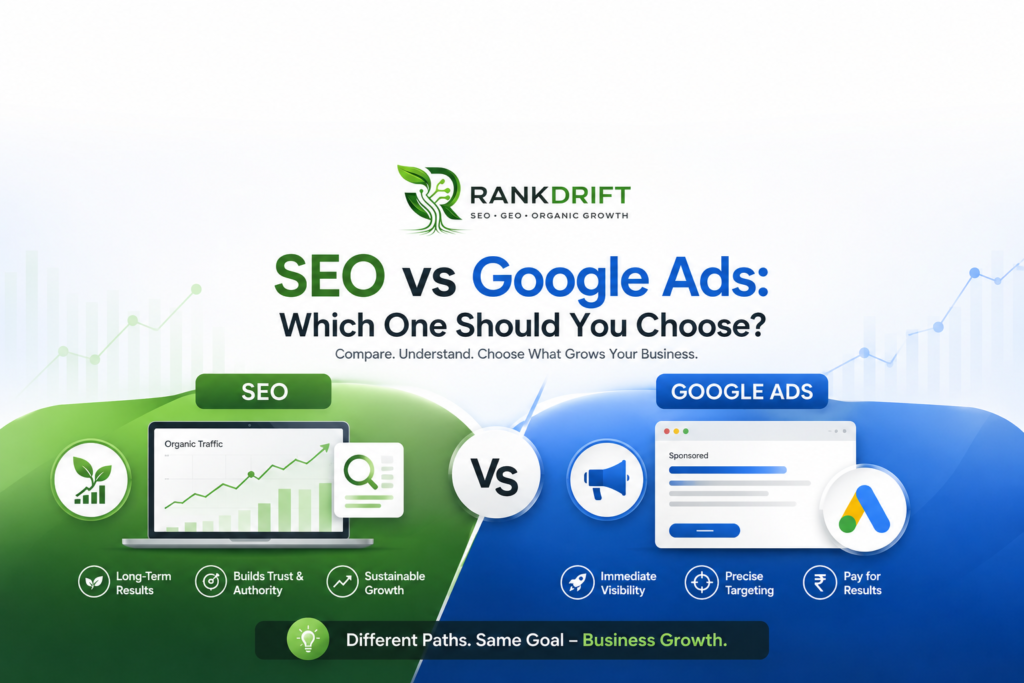
In India, Google accounted for 97.85% of search-engine market share in June 2026, making visibility on Google a major acquisition opportunity for businesses. The real question is not whether search matters, but whether your business should invest more heavily in SEO vs Google Ads — or use both strategically.
SEO and Google Ads can generate qualified traffic, but they work on very different timelines. SEO builds organic visibility that can compound over time, while Google Ads can put your offer in front of searchers almost immediately.
Why the SEO vs Google Ads Decision Matters
Search traffic is valuable because it captures people actively looking for information, products, or services. But paying for every click and building organic visibility are two very different growth models.
Google explains that organic Search results are generated by automated ranking systems that evaluate many signals to determine which pages are relevant and useful. Google also states that businesses do not pay Google to rank their organic pages higher.
Google Ads works differently. You set a campaign budget and bidding strategy, and Google uses its ad auction to determine when and where your ads appear. Your maximum CPC represents the most you’re willing to pay for a click, while actual costs can vary based on the auction and ad quality.
That creates a fundamental difference:
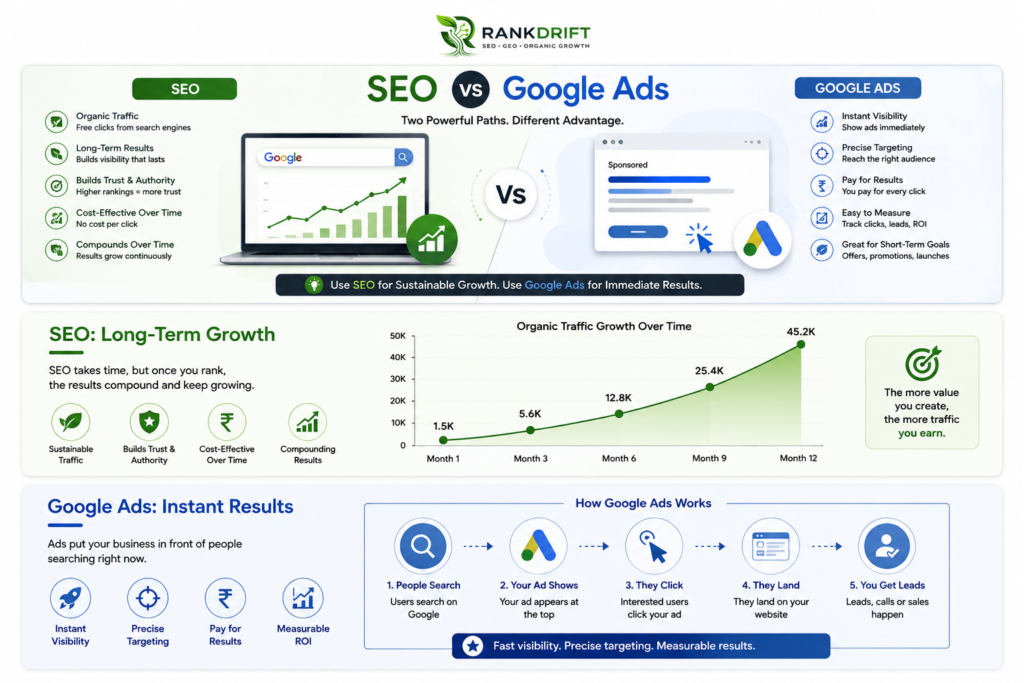
SEO builds an asset. Google Ads buys targeted exposure.
For many Indian businesses, the strongest strategy is not choosing one permanently. It is knowing when each channel makes financial and strategic sense.
SEO vs Google Ads: The Core Difference
SEO, or Search Engine Optimization, improves your website’s ability to appear in Google’s unpaid search results. It involves technical optimization, content, internal linking, keyword targeting, user experience, authority building, and other activities that help search engines understand and trust your pages.
Google Ads is paid search advertising. You choose keywords, audiences, locations, budgets, bidding strategies, and landing pages, then compete in Google’s advertising auction for relevant opportunities.
Google’s own documentation confirms that organic ranking is separate from advertising: paying Google does not make a website rank higher in organic Search.
| Factor | SEO | Google Ads |
|---|---|---|
| Traffic source | Organic | Paid |
| Initial visibility | Usually slower | Usually faster |
| Direct media cost | No payment to Google for organic clicks | Advertiser pays according to campaign/bidding model |
| Long-term value | Can compound | Requires ongoing spend |
| Control over targeting | Moderate | High |
| Testing speed | Slower | Fast |
| Best for | Sustainable visibility | Immediate demand capture |
| Main challenge | Time and consistency | Cost and optimization |
| Useful for | Long-term growth | Short-term campaigns and lead generation |
The distinction matters because the wrong channel can create the wrong expectations.
If you need leads for a promotion starting next week, waiting months for SEO results may not be practical. If you want to build a consistent acquisition channel for the next three years, relying exclusively on paid clicks can become expensive.
When SEO Is the Better Choice
SEO makes more sense when your business wants to build long-term organic demand around problems, services, products, and commercial searches.
Suppose you run a digital marketing agency in Delhi. Instead of only bidding on “digital marketing agency Delhi,” an SEO strategy could target a wider search ecosystem:
- SEO agency in Delhi
- local SEO services
- technical SEO services
- SEO audit services
- Google ranking strategies
- SEO for small businesses
- SEO pricing in India
Each useful page can target a different search intent and create another opportunity to attract potential customers.
Google’s Search Essentials emphasize technical accessibility, spam compliance, and best practices that help content perform in Search. Google also notes that simply meeting the requirements does not guarantee crawling, indexing, or ranking.
That last point is important.
SEO is not a guaranteed ranking purchase. It is a process of improving your site’s ability to earn visibility.
SEO works particularly well when:
Your customers search before buying.
Businesses selling services such as accounting, consulting, healthcare, education, software, home services, and professional services can benefit when prospects research solutions through Google.
You have a longer customer lifetime value.
If one organic visitor can eventually become a customer worth ₹50,000 or ₹1 lakh, investing in content and organic visibility can make strategic sense.
You want to reduce dependence on paid traffic.
Organic rankings can continue bringing qualified visitors without paying Google for every individual organic click.
You have time to build.
SEO usually requires consistent work rather than a one-time optimization.
When Google Ads Is the Better Choice
Google Ads becomes attractive when speed, targeting, and measurable campaign control matter more than building organic visibility first.
For example, imagine an Indian education company launching admissions for a course in the next 30 days. Waiting for a new SEO page to establish organic visibility may not align with the enrollment deadline.
A properly structured Google Ads campaign can begin competing for relevant search opportunities much faster.
Google lets advertisers control campaign budgets and bidding strategies. Its documentation also explains that Maximize Clicks can automatically manage bids to generate as many clicks as possible within a campaign’s budget.
Google Ads is particularly useful when:
You need immediate traffic.
A new business with little organic visibility can use paid search to start testing demand.
You have a time-sensitive offer.
Sales, events, admissions, product launches, seasonal services, and limited-time promotions can benefit from fast visibility.
You want precise campaign control.
You can adjust budgets, bids, locations, devices, keywords, and campaign settings based on performance.
You already know which keywords convert.
Paid search can help you identify commercial keywords that generate leads or sales before you build long-term SEO content around them.
Google also provides conversion tracking so advertisers can understand what happens after someone clicks an ad, including whether that visitor purchases or signs up.
SEO vs Google Ads: What Should a Business Invest In?
The answer depends on your business stage, budget, customer journey, and growth objective.
A startup with no organic visibility may need Google Ads to generate initial demand while simultaneously building SEO foundations. An established company with strong rankings may shift more budget toward SEO while using Ads for competitive keywords, new offers, and high-value campaigns.
| Business Situation | SEO Priority | Google Ads Priority |
|---|---|---|
| New website | High | High |
| Immediate lead requirement | Medium | Very High |
| Long-term lead generation | Very High | Medium |
| Seasonal promotion | Low–Medium | Very High |
| Competitive commercial keywords | High | High |
| Limited monthly advertising budget | High | Medium |
| Established organic traffic | Very High | Medium |
| New product launch | Medium | Very High |
| Local service business | High | High |
| Brand building over several years | Very High | Medium |
These aren’t fixed rules. Your actual decision should come from data.
For example, if Google Ads shows that “technical SEO services” produces qualified leads at an acceptable acquisition cost, that insight can influence your SEO content strategy. Instead of guessing which keywords matter, you have real campaign data to inform future organic investment.
The Strongest Strategy: Use SEO and Google Ads Together
For many businesses, the best answer to SEO vs Google Ads is actually SEO + Google Ads.
Think of the two channels as serving different stages of the acquisition process.
Google Ads can help you test:
Which keywords generate clicks?
Which offers attract attention?
Which landing pages convert?
Which locations produce qualified leads?
SEO can then help you build lasting visibility around the opportunities that prove commercially valuable.
This creates a feedback loop.
Google Ads → keyword and conversion data → SEO content → organic visibility → lower dependence on paid acquisition.
At the same time, SEO data can improve paid campaigns. Your organic search queries can reveal new keywords, questions, locations, and customer pain points worth testing through advertising.
Google’s current guidance also makes SEO increasingly relevant beyond traditional blue-link results. Google states that its AI features, including AI Overviews and AI Mode, rely on core Search systems and that existing SEO fundamentals remain important.
That means building strong search visibility isn’t simply about one traditional ranking position anymore.
Common Mistakes Businesses Make
1. Expecting SEO to produce instant leads
SEO can be powerful, but publishing a few pages does not guarantee immediate rankings or conversions. Google explicitly says that crawling, indexing, and serving are not guaranteed.
Treat SEO as a growth investment that requires measurement and iteration.
2. Treating Google Ads as a permanent substitute for SEO
Ads can generate traffic quickly, but the campaign remains dependent on budget and performance. When the campaign stops, that paid traffic opportunity generally stops with it.
Google Ads itself provides tools for controlling average daily budgets and campaign spending, highlighting the fact that paid acquisition is an ongoing budget decision.
3. Measuring SEO only by rankings
Ranking position is useful, but business outcomes matter more.
Track:
- Organic qualified traffic
- Leads
- Sales
- Conversion rate
- Revenue
- Assisted conversions
- Non-brand search growth
A keyword ranking in position three is not automatically valuable if it generates no relevant business.
4. Running Google Ads without conversion tracking
Clicks aren’t the final objective.
If you spend ₹50,000 on Ads but don’t know which campaigns generated qualified leads, you cannot properly evaluate ROI.
Google recommends conversion tracking to understand what happens after users click an ad and to calculate actual return on investment.
A Practical Decision Framework for Your Business
Before choosing between SEO and Google Ads, answer these five questions.
1. How quickly do you need results?
If the answer is days or weeks, prioritize Google Ads.
If you can invest over months and years, build SEO aggressively.
2. What’s the value of one customer?
A business with a high customer lifetime value can often justify a more substantial investment in both channels.
3. How competitive are your keywords?
Extremely competitive keywords can require substantial SEO effort. Ads may provide faster access to the market, although the cost per click can also be high.
4. Does your business have recurring demand?
If customers repeatedly search for your products or services, SEO becomes more attractive because the same organic visibility can support ongoing discovery.
5. Can you convert the traffic?
Neither SEO nor Google Ads can compensate for a poor landing page, weak offer, unclear CTA, or slow sales process.
Traffic is only valuable when it can move people toward a business outcome.
A Simple 90-Day Approach
If you’re unsure where to start, use a combined testing model.
Days 1–30:
Audit your website, identify high-intent keywords, set up conversion tracking, improve important landing pages, and launch tightly controlled Google Ads campaigns where immediate demand exists.
Days 31–60:
Use campaign data to identify profitable search terms. Build or improve SEO pages around valuable topics and strengthen internal linking between relevant pages.
Days 61–90:
Compare paid and organic performance based on qualified leads and revenue. Increase investment in channels that are producing business results rather than simply generating traffic.
This approach reduces guesswork.
SEO vs Google Ads: The Bottom Line
There is no universal winner.
Choose SEO when your priority is sustainable organic visibility, long-term lead generation, and building a search asset that can continue producing value. Choose Google Ads when you need immediate visibility, precise targeting, or fast testing of commercial demand.
For businesses serious about growth, the smarter approach is often to let Google Ads capture immediate demand while SEO builds future demand.
At RankDrift, the goal should not be simply to get more clicks. The goal is to build search visibility that contributes to qualified traffic, leads, and measurable business growth.
FAQs
Is SEO better than Google Ads?
Not always. SEO is generally better suited to long-term organic visibility, while Google Ads is better suited to immediate paid exposure. The right choice depends on your goals, budget, competition, and timeline.
Can SEO replace Google Ads?
For some businesses, strong organic visibility can reduce dependence on paid search. However, Ads can still be useful for competitive keywords, launches, seasonal campaigns, and testing new offers.
Does Google Ads improve organic rankings?
No. Google states that payment for advertising does not result in higher organic rankings. Organic Search and paid advertising operate separately.
How long does SEO take to work?
There is no universal timeline. Results depend on competition, website authority, technical condition, content quality, search demand, and the amount of consistent SEO work. Google does not guarantee that a page will rank simply because it follows its guidelines.
Should a small business use SEO and Google Ads together?
Often, yes. Google Ads can provide faster data and traffic while SEO builds longer-term visibility. Using both can help a business balance immediate acquisition with sustainable growth.