Google’s first page captures 96.98% of desktop clicks and 97.56% of mobile clicks, according to Ahrefs’ analysis of billions of Google Search Console clicks from August 2025. That makes search visibility commercially important but it also explains why so many businesses fall for shortcuts, ranking guarantees, and outdated SEO advice.
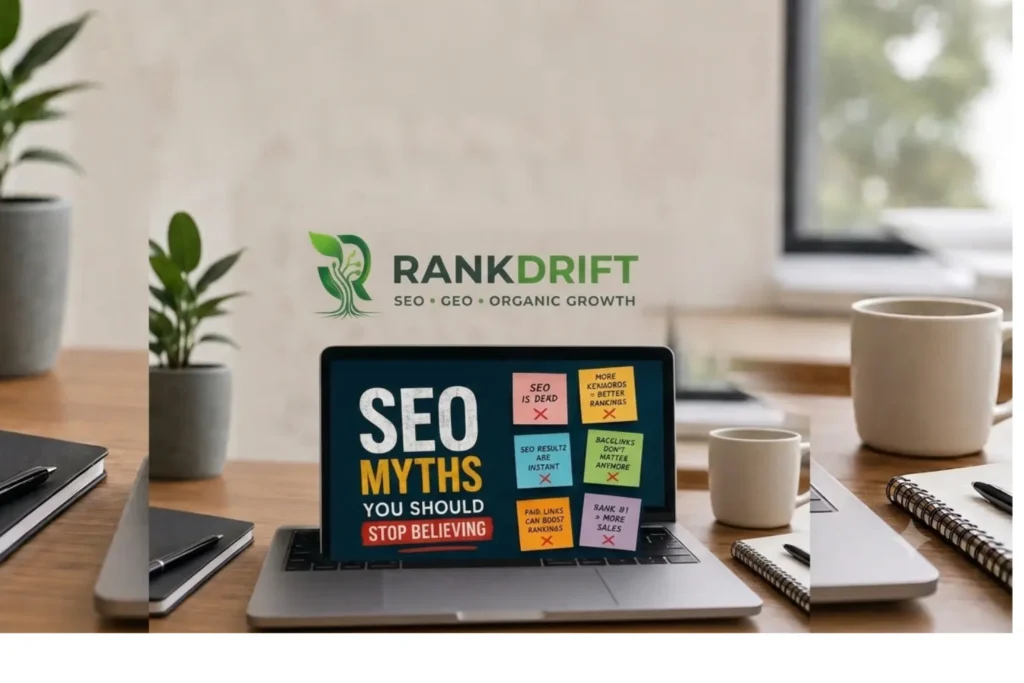
We see the same SEO myths repeatedly: “More keywords mean better rankings,” “SEO takes exactly six months,” “Google rewards fresh content,” “Backlinks are dead,” and “ranking #1 guarantees traffic.” Most of these statements contain a small piece of truth wrapped in an oversimplification.
For businesses investing in SEO, the distinction matters. The wrong belief can lead to wasted content budgets, risky link-building, unnecessary website changes, and months spent measuring metrics that have little relationship with revenue.
Why SEO Myths Are Still a Business Problem?
Google’s own Search Essentials do not provide a secret formula for reaching position one. Instead, Google emphasizes technical accessibility, spam compliance, and helpful, reliable, people-first content. It also explicitly states that following these best practices does not guarantee that a page will be crawled, indexed, or served in search results.
Search behaviour has also become more complicated. Ahrefs reports that 61.5% of desktop searches and 34.4% of mobile searches result in no clicks, while Google says that 15% of searches have never been searched before.
That means we should stop treating SEO as a simple exercise of inserting keywords and chasing a single ranking position.
| Old SEO assumption | More useful business interpretation |
|---|---|
| Rankings are the goal | Qualified visibility and conversions are the goal |
| One keyword = one page | One search intent can cover a topic cluster |
| More keywords = better SEO | Relevant coverage and intent matter more |
| More backlinks = higher rankings | Relevant, credible links are more valuable |
| SEO has a fixed timeline | Results depend on competition, site condition and execution |
| #1 means maximum traffic | SERP features, intent and click behaviour affect traffic |
| Publish constantly | Improve the pages and topics that matter |
| AI content automatically hurts SEO | Low-value, search-engine-first content is the problem |
These distinctions are especially important for Indian businesses competing in crowded categories such as healthcare, SaaS, education, e-commerce, finance, real estate, and local services.
Myth #1: More Keywords on a Page Mean Better Rankings
One of the oldest SEO myths is that a page becomes more relevant when we repeat the target keyword as many times as possible.
It does not.
Google explicitly defines keyword stuffing as filling a page with keywords or numbers in an attempt to manipulate rankings. Repeating the same phrase unnaturally can fall under Google’s spam policies.
The better approach is to understand the search intent behind the keyword.
Suppose we want to rank a page for:
SEO agency in Delhi
We do not need to repeat that exact phrase dozens of times. We need to answer the questions a potential customer has before contacting an agency:
- What does an SEO agency actually do?
- Which SEO services are included?
- How long can results take?
- What industries does the agency understand?
- How are results measured?
- What does reporting look like?
- What separates technical SEO from content SEO?
- How does SEO support leads and revenue?
Google’s SEO Starter Guide recommends using words people would use to search for the content, particularly in descriptive locations such as titles and headings but it does not recommend mechanical repetition.
Our rule: optimize for topic coverage and search intent, not keyword density.
Myth #2: SEO Takes Exactly 3 or 6 Months
We should be careful whenever an SEO provider gives a fixed deadline such as “you will rank in 90 days.”
There is no universal SEO clock.
Google explains that improvements can sometimes affect Search results within days, while other changes can take several months for Google’s systems to recognize and evaluate.
A new local service website targeting a low-competition query is fundamentally different from an established e-commerce site attempting to outrank hundreds of authoritative competitors.
We can therefore think about SEO timelines in terms of conditions rather than promises:
| Situation | Likely SEO challenge |
|---|---|
| New website + low competition | Building initial relevance and authority |
| Established website + technical problems | Fixing crawl, indexing and performance issues |
| Strong website + weak content | Improving intent alignment and topical coverage |
| Competitive national keyword | Building authority and differentiated content |
| Local business | Strengthening local relevance, reviews and location signals |
| Existing page ranking 11–20 | Often an opportunity for targeted optimization |
The practical question is not “Will SEO work in six months?”
It is:
“Which measurable improvements should we expect as the campaign progresses?”
We should track technical health, indexed pages, impressions, rankings, qualified organic traffic, leads and conversions not simply promise a date on which rankings will magically appear.
Myth #3: Ranking #1 Automatically Means More Customers
Position matters. It just is not the same thing as business success.
Ahrefs’ research shows that first page visibility dominates organic clicks, but its own documentation also warns that search volume alone does not tell us how many people will actually click. Search features can answer queries directly inside Google, reducing clicks to websites.
Consider two hypothetical keywords:
| Keyword | Monthly searches | Position | Commercial value |
|---|---|---|---|
| “what is SEO” | 50,000 | #1 | Potentially low |
| “SEO agency for SaaS companies” | 1,000 | #3 | Potentially high |
The second query may generate fewer visitors but substantially stronger commercial intent.
For a business, we should therefore evaluate:
Visibility → Clicks → Engagement → Leads → Sales
A ranking report that celebrates position #1 without showing what happened to qualified traffic or enquiries tells only part of the story.
Myth #4: Backlinks Are Dead
The opposite claim is equally misleading: “Just get as many backlinks as possible.”
Google’s documentation confirms that links can help it discover pages and understand relevance.
But Google’s spam policies specifically warn against link spam, including buying links for ranking purposes, excessive link exchanges, automated link creation, and low-quality tactics designed primarily to manipulate rankings.
So we should separate link acquisition from link manipulation.
Quantity-first approach
- Thousands of low-quality directory links
- Automated guest-post networks
- Exact-match anchor text everywhere
- Paid links intended to pass ranking credit
- Irrelevant websites
Authority-first approach
- Relevant industry publications
- Genuine digital PR
- Useful research worth citing
- Expert contributions
- Strong editorial mentions
- Partnerships that naturally reference the business
The objective is not to collect a backlink count.
The objective is to earn references that make sense to both users and search systems.
Myth #5: Publishing More Blog Posts Always Improves SEO
Publishing 30 articles is not automatically better than publishing five excellent ones.
Google’s guidance emphasizes unique, useful, up-to-date content and specifically advises against creating content primarily to manipulate search rankings.
This is where topical strategy becomes more valuable than a publishing quota.
Instead of publishing random articles such as:
- What is SEO?
- What is digital marketing?
- Why is social media important?
- What is content marketing?
we can build a focused topic cluster around the actual business.
For an Indian healthcare brand, for example, the strategy could connect:
service page → condition/topic page → treatment guide → location page → FAQ → supporting educational content
Internal links then connect related pages logically.
Google states that links help it discover pages and understand relationships between pages, making internal linking useful for both users and search engines.
The better question is not “How many blogs did we publish?”
It is “How much useful search demand did our content portfolio cover?”
Myth #6: Fresh Content Always Ranks Better
Freshness is frequently misunderstood.
Updating an article can be valuable when the information has genuinely changed. But changing a publication date or rewriting a few sentences simply to make an old page appear new is not a sustainable SEO strategy.
Google’s own guidance recommends keeping content up to date when necessary, while its core-update documentation warns against making quick changes simply because we heard a particular element is “bad for SEO.”
We should update content when there is a reason:
- New regulations
- New pricing
- New product specifications
- New research
- Changed search intent
- Outdated examples
- Broken links
- Missing information
- Competitors providing substantially better answers
Useful freshness beats cosmetic freshness.
Myth #7: AI-Generated Content Is Automatically Penalized
This is one of the newer SEO myths.
The issue is not simply whether a human or AI typed the first draft. Google’s guidance focuses on whether content is helpful, reliable and created primarily for people, rather than primarily for manipulating search rankings.
That creates an important distinction:
| Low-value AI workflow | Responsible AI-assisted workflow |
|---|---|
| Generate 100 generic articles | Research topics based on real customer needs |
| Publish without review | Expert reviews and fact-checks |
| Rephrase competitors | Add original insights and evidence |
| Repeat the same template | Build content around actual search intent |
| Invent statistics | Verify every factual claim |
| Optimize only for keywords | Optimize for users, clarity and usefulness |
For professional websites, human expertise still matters enormously. AI can accelerate research, outlining, editing and content operations, but it should not become an excuse for publishing interchangeable pages with no original value
Common SEO Mistakes We Should Stop Making
The most expensive mistakes are often not dramatic technical failures. They are decisions based on outdated assumptions.
1. Measuring only keyword positions
Rankings fluctuate and different users can see different search experiences. We should connect ranking data with impressions, clicks, conversions and revenue.
2. Chasing high-volume keywords
High search volume does not automatically mean high business value. Commercial intent and relevance should influence keyword prioritization.
3. Treating every traffic drop as a penalty
Google says broad core updates are designed to improve the overall quality of results and do not target specific sites or pages. It recommends assessing affected pages and avoiding drastic “quick fixes.”
4. Buying backlinks at scale
Google explicitly identifies manipulative link practices as spam.
5. Creating content without a page strategy
Every important keyword should have a clear destination and purpose.
6. Ignoring existing pages
Sometimes the fastest opportunity is not a new blog. It is improving a page already receiving impressions but failing to convert those impressions into clicks or enquiries.
A Practical SEO Myth-Busting Checklist
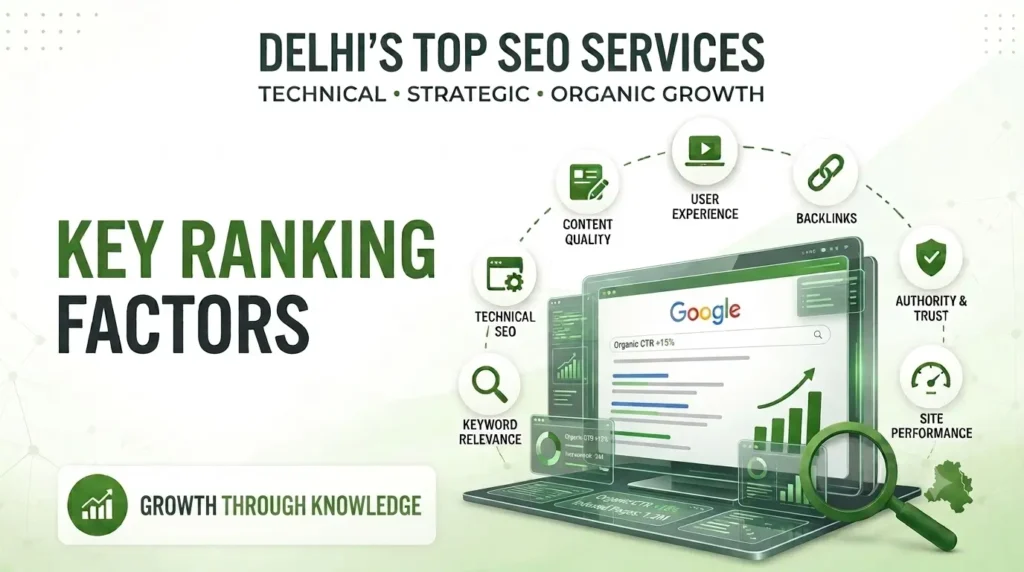
We can use this checklist before approving the next SEO activity:
- Check the claim against Google Search Central.
If an SEO tactic sounds like a secret loophole, verify it against Google’s documentation. - Identify the search intent.
Determine whether the query is informational, commercial, navigational, transactional or local. - Measure business relevance.
Ask whether ranking for the keyword could realistically attract the right customer. - Audit existing pages first.
Look for pages already ranking between positions 4 and 20 before creating another URL. - Build topical depth.
Cover the important questions surrounding the main topic rather than repeating one keyword. - Strengthen internal links.
Connect related pages using descriptive, useful anchor text. - Earn authority instead of manufacturing links.
Prioritize relevant editorial mentions, partnerships and digital PR. - Use Search Console as a decision-making tool.
Monitor impressions, clicks, queries and page performance instead of relying only on third-party estimates. - Review content quality regularly.
Remove inaccuracies, improve weak sections and add information that genuinely helps users. - Report outcomes, not activity.
“Published 12 blogs” is an activity metric. “Organic leads increased from X to Y” is a business outcome.
Frequently Asked Questions About SEO Myths
Is keyword density still a Google ranking factor?
We should not build an SEO strategy around a specific keyword density percentage. Google’s spam policies identify unnatural keyword repetition as keyword stuffing, while its Search Essentials recommend using relevant language naturally and prominently.
How long does SEO actually take?
There is no universal timeline. Google states that some improvements can take effect within days, while others may take several months to be reflected in Search systems. Competition, site history, technical condition, content quality and authority all affect the pace.
Are backlinks still important for SEO?
Links remain useful for discovery and relevance, but quality and context matter more than simply increasing the number of links. Manipulative link-building practices can violate Google’s spam policies.
Does AI-generated content hurt Google rankings?
AI assistance itself should not be treated as the entire SEO question. The more important issue is whether the resulting content is useful, original, accurate and created for people rather than primarily to manipulate rankings.
What should we measure instead of rankings?
We should connect rankings with impressions, organic clicks, qualified traffic, leads, conversions and revenue. Rankings are useful diagnostic indicators, but they are not the final business outcome.
The SEO Belief We Should Keep
The most useful shift is simple: we should stop looking for SEO tricks and start looking for search opportunities.
Google’s current guidance consistently points toward useful content, accessible websites, relevant links, strong user experience and sustainable practices not secret keyword formulas or guaranteed ranking shortcuts.
Search is also expanding beyond traditional blue links. RankDrift’s approach reflects this shift by combining traditional SEO with GEO and AEO, aiming to improve visibility across Google, AI assistants and answer engines.
For businesses evaluating SEO agencies, the strongest question is therefore not “How fast can you get us to #1?”
It is:
“Can you show us what you will improve, why it matters to our customers, and how those improvements will be measured?”
That is the difference between buying SEO activity and building a search-growth strategy.
Final Thought
At the end of the day, Google doesn’t pay your bills customers do. Ranking #1 is only a victory if it drives qualified clicks, builds trust, and generates actual leads. Ditch the outdated shortcuts, focus on intent and topic coverage, and build a search strategy designed for real growth, not vanity metrics.