
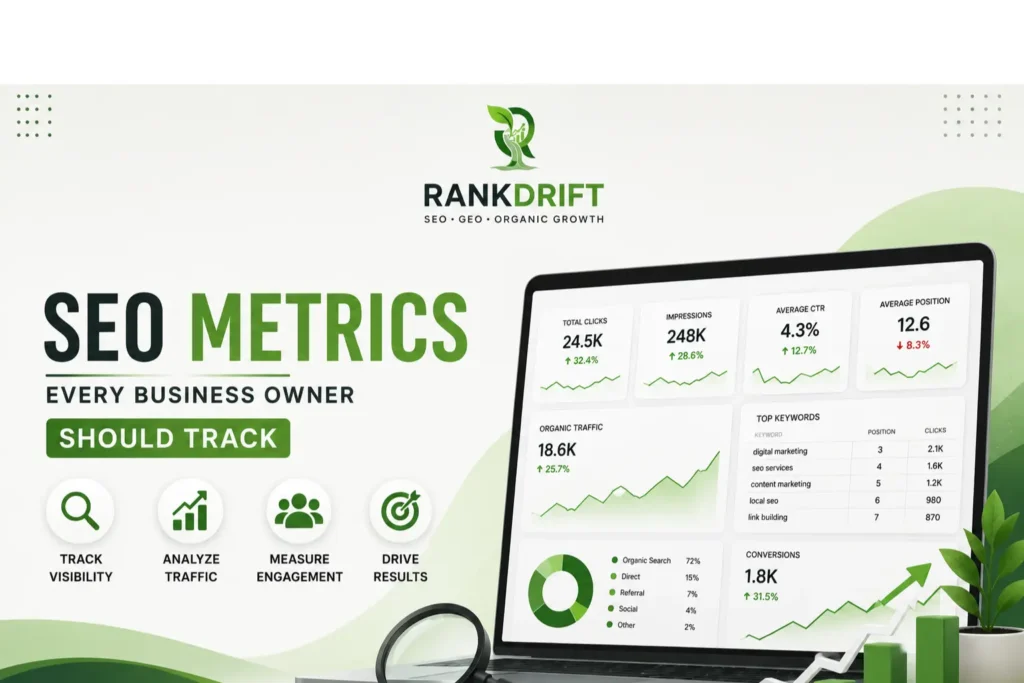
Every business owner investing in SEO needs evidence that the investment produces measurable business value. Rankings alone cannot provide that evidence. You need visibility, traffic, engagement, conversion, and revenue metrics working together. Google Search Console reports clicks, impressions, click-through rate, and average position for Google Search performance. Therefore, effective SEO reporting should connect search visibility with what happens after someone reaches your website.
This guide covers the SEO metrics every business owner should track and explains how to interpret them correctly.
Why SEO Metrics Matter for Every Business Owner?
SEO generates large amounts of data. However, more data does not automatically create better decisions. A business owner needs metrics that answer three practical questions.
Is the business becoming more visible?
Does that visibility generate qualified traffic?
Can that traffic create measurable business results?
That distinction matters because improving one SEO metric does not guarantee improvements elsewhere. For example, impressions could increase while clicks remain unchanged. Likewise, organic traffic could increase without generating additional enquiries.
Google recommends focusing on trends in impressions and clicks rather than relying heavily on position alone.Therefore, your SEO dashboard should measure the complete journey.
Search visibility → Search clicks → Website engagement → Leads → Customers → Revenue
This framework makes SEO performance easier to understand and improves decision-making.
1. Organic Clicks: Measure Traffic Coming Directly From Search
Organic clicks show how many users clicked your website from unpaid Google Search results. Google Search Console records a click when someone clicks a search result leading to your website. For a business owner, clicks provide a clearer performance signal than rankings alone.
Suppose your website moves from position nine to position five for several keywords. That improvement looks positive.
However, the improvement has limited commercial value if nobody clicks those results.
Therefore, compare organic clicks across meaningful periods.
Compare the latest 28 days against the previous 28 days. Also compare quarterly and year-over-year performance. Seasonal businesses should prioritize year-over-year comparisons because monthly demand can fluctuate significantly.
What to Check?
Monitor total organic clicks, clicks by landing page, clicks by query, and branded versus non-branded performance. Google introduced branded and non-branded query filtering within Search Console performance analysis. Non-branded clicks can be particularly useful for measuring discovery among audiences unfamiliar with your company.
2. Search Impressions: Understand Your Growing Visibility
An impression generally indicates that a link to your website appeared to a user on Google. However, exact counting rules depend on the search result format. Impressions often increase before clicks increase.
Therefore, they can reveal whether SEO improvements are expanding your potential search visibility.
Imagine a website receiving 20,000 monthly impressions and 800 clicks. Three months later, impressions reach 35,000 while clicks remain around 800. Visibility has clearly improved. Yet the website has failed to convert that visibility into additional search traffic.
That situation requires deeper investigation. You should review keyword relevance, ranking positions, search intent, page titles, and search snippets. Google specifically recommends investigating high-impression queries that generate unexpectedly low click activity.
For a business owner, rising impressions are encouraging only when they eventually contribute to meaningful traffic.
3. Organic Click-Through Rate: Measure Search Result Effectiveness
Click-through rate connects impressions with actual visits. Google calculates Search Console CTR using this formula:
CTR = Clicks ÷ Impressions
Therefore, 500 clicks from 10,000 impressions produce a 5% CTR.
However, CTR should never be evaluated without context.
Ranking position, search intent, brand awareness, device type, SERP features, and query type can influence CTR. A low CTR does not automatically indicate poor SEO. However, unusually low CTR on important queries can reveal optimization opportunities.
Google suggests reviewing titles, descriptions, content alignment, and query relevance when pages receive impressions without expected clicks. A business owner should particularly watch high-impression commercial pages with weak click-through performance. Those pages already have visibility. Therefore, improving their search presentation can create gains without producing entirely new content.
4. Keyword Rankings and Average Position
Rankings remain useful, but they should support your analysis rather than dominate it. Search Console defines average position using the topmost result from your property for each search impression.
That creates an important limitation. An average position of 6.5 does not mean your website always appears exactly around position six. Search results vary based on queries, locations, devices, and other factors. Google itself describes position as a complex metric and recommends monitoring changes over time.
Therefore, prioritize keyword groups instead of obsessing over individual keyword movements.
Track:
- Commercial keywords
- Product or service keywords
- Local-intent searches
- Informational queries
- Branded searches
- High-conversion keywords
This approach gives a business owner a clearer picture of meaningful search visibility.
5. Organic Traffic and Engagement
Clicks explain what happens inside Google. Website analytics explain what happens after the click. That distinction makes Google Analytics essential for SEO measurement. GA4 defines an engaged session as one meeting at least one qualifying condition. The session lasts longer than ten seconds, triggers a key event, or generates at least two page views. Engagement rate represents the percentage of sessions classified as engaged sessions. Therefore, increasing organic sessions should not be your only objective.
You should also evaluate whether visitors actually interact with the website.
SEO Performance Metrics at a Glance
| SEO Metric | What It Measures | Primary Tool | Why It Matters |
|---|---|---|---|
| Organic Clicks | Search-generated visits | Search Console | Measures actual search traffic |
| Impressions | Search visibility | Search Console | Shows visibility growth |
| CTR | Clicks relative to impressions | Search Console | Measures SERP effectiveness |
| Average Position | Approximate search placement | Search Console | Tracks ranking trends |
| Organic Sessions | Website visits from organic search | GA4 | Measures traffic volume |
| Engagement Rate | Meaningful website interaction | GA4 | Evaluates traffic quality |
| Key Events | Important user actions | GA4 | Connects traffic with outcomes |
| Conversion Rate | Visitors completing goals | GA4/CRM | Measures commercial effectiveness |
| Core Web Vitals | Real-world page experience | Search Console | Identifies experience problems |
| Organic Revenue | Revenue attributed to organic users | Analytics/CRM | Measures SEO business impact |
This table shows why no single metric can accurately represent overall SEO performance.
6. Conversions and Key Events
Traffic becomes valuable when visitors complete meaningful actions. Those actions differ between businesses. An ecommerce company may prioritize purchases. A service company might prioritize enquiry submissions or qualified calls. Meanwhile, SaaS companies might track trial registrations or demo requests. GA4 supports key events for measuring actions that matter to a business.
Therefore, configure events around genuine commercial outcomes rather than meaningless interactions.
A business owner should know which organic landing pages generate the highest number of qualified actions.
Consider this illustrative example:
| Landing Page | Organic Sessions | Leads | Conversion Rate |
|---|---|---|---|
| Service Page A | 1,000 | 60 | 6% |
| Blog Article B | 3,000 | 30 | 1% |
| Location Page C | 600 | 48 | 8% |
Blog Article B generates the most traffic.
However, Location Page C produces stronger commercial performance. Without conversion tracking, the business might incorrectly prioritize Article B.
7. Organic Conversion Rate
Organic conversion rate measures how effectively organic visitors complete desired actions.
A simplified calculation is:
Organic Conversion Rate = Organic Conversions ÷ Organic Sessions × 100
Suppose 2,000 organic sessions produce 100 qualified enquiries. The resulting conversion rate equals 5%. Now imagine organic traffic grows to 3,000 sessions while enquiries remain at 100. Traffic increased by 50%, but commercial output remained unchanged. A business owner should investigate that pattern rather than automatically celebrating traffic growth. Potential causes include weak search intent, poor landing pages, confusing forms, ineffective offers, or irrelevant keyword targeting. SEO teams and conversion teams should examine these issues together.
8. Core Web Vitals and Technical Performance
SEO success depends partly on whether users receive a strong page experience. Google’s Core Web Vitals currently focus on three primary measurements.
Largest Contentful Paint (LCP) measures loading performance.
Interaction to Next Paint (INP) measures responsiveness.
Cumulative Layout Shift (CLS) measures visual stability.
Google recommends an LCP within 2.5 seconds, INP below 200 milliseconds, and CLS below 0.1. Search Console evaluates Core Web Vitals using real-world usage data. Its reporting considers the 75th percentile of page experiences across a 28-day measurement period. Technical performance should therefore remain part of every serious SEO reporting process.
However, improving Core Web Vitals should complement strong content and relevance rather than replace them.
9. Organic Revenue and SEO ROI
Revenue represents the metric closest to what most businesses ultimately want. However, calculating SEO return requires reliable analytics and cost data.
A simplified calculation is:
SEO ROI = (Organic Profit − SEO Cost) ÷ SEO Cost × 100
Suppose SEO generates ₹5,00,000 in attributable profit while costing ₹2,00,000. The simplified SEO ROI would equal 150%. However, attribution can become complicated.
Customers may discover your business organically before returning through another channel. Therefore, combine analytics, CRM information, lead quality, and sales data whenever possible. A business owner should evaluate SEO as a business acquisition channel rather than merely a ranking exercise.
10. Branded vs Non-Branded Search Performance
Branded searches include your company or product name. Non-branded searches generally represent users discovering solutions without specifically searching for your company. This distinction helps measure whether SEO expands your audience beyond existing brand awareness. Google notes that branded traffic often involves users already familiar with a website. Non-branded traffic can indicate new audience growth.
Therefore, increasing non-branded visibility can indicate stronger category-level discoverability. However, branded growth also matters.
Increasing branded searches may reflect stronger overall awareness created through multiple marketing channels. Track both separately to avoid misinterpreting SEO growth.
Common SEO Metrics Mistakes Business Owners Make
Tracking Rankings Without Business Outcomes
Ranking first feels valuable.
However, ranking for irrelevant queries may produce little revenue. Connect priority keywords with landing pages, conversions, and qualified leads.
Celebrating Traffic Without Checking Intent
More traffic does not automatically mean better SEO. A smaller group of high-intent visitors can outperform thousands of irrelevant sessions.
Reviewing Metrics Separately
Clicks, rankings, engagement, and conversions influence each other. Therefore, evaluate them as one customer journey.
Using Short Reporting Windows
SEO performance naturally fluctuates. Compare monthly, quarterly, and year-over-year trends before making major strategic decisions.
Ignoring Measurement Problems
Incorrect analytics configuration can make excellent campaigns appear weak. Likewise, broken event tracking can hide genuine conversions. Audit measurement before making decisions based on questionable data.
Practical SEO Metrics Checklist for Every Business Owner
- Check Search Console clicks monthly. Compare recent performance with previous and year-over-year periods.
- Review impressions by page and query. Identify where search visibility is expanding.
- Find high-impression, low CTR opportunities. Improve titles, snippets, relevance, and search intent alignment.
- Track commercial keyword groups. Prioritize keywords connected with products, services, and buying decisions.
- Monitor organic engagement. Check whether search visitors meaningfully interact with your website.
- Measure key events and conversions. Track enquiries, calls, purchases, bookings, or other meaningful actions.
- Calculate organic conversion rates. Identify pages producing traffic without enough business results.
- Review Core Web Vitals. Prioritize recurring technical problems affecting important pages.
- Separate branded and non-branded performance. Understand discovery growth versus existing brand demand.
- Connect SEO with revenue. Combine analytics and CRM data wherever your measurement setup allows.

Frequently Asked Questions
What SEO metrics should a business owner track first?
Start with organic clicks, impressions, CTR, conversions, and organic revenue. Then add engagement, keyword trends, Core Web Vitals, and branded versus non-branded performance.
How often should SEO metrics be reviewed?
Review major SEO metrics monthly for strategic reporting. However, teams can monitor Search Console more frequently when diagnosing changes or evaluating recently published content. Google Search Console also provides a 24-hour performance view with recent clicks, impressions, CTR, and position data.
Is organic traffic the most important SEO metric?
Not necessarily. Organic traffic measures visits, while conversions and revenue reveal whether those visits support business goals. Therefore, traffic should always be evaluated alongside quality and commercial outcomes.
Should a business owner focus on keyword rankings?
Track rankings as directional indicators rather than final success metrics. Google recommends giving meaningful attention to impression and click trends instead of relying on position alone.
How can you tell whether SEO is actually working?
Look for connected improvements across visibility, clicks, qualified traffic, conversions, and commercial outcomes. Sustainable growth across several stages provides stronger evidence than a single ranking increase.
Final Thought
The best SEO dashboard is not the one containing the most numbers. It is the one that helps a business owner make better decisions. Track visibility, clicks, engagement, conversions, and revenue as one connected system. Then use those insights to decide what deserves your next SEO investment.