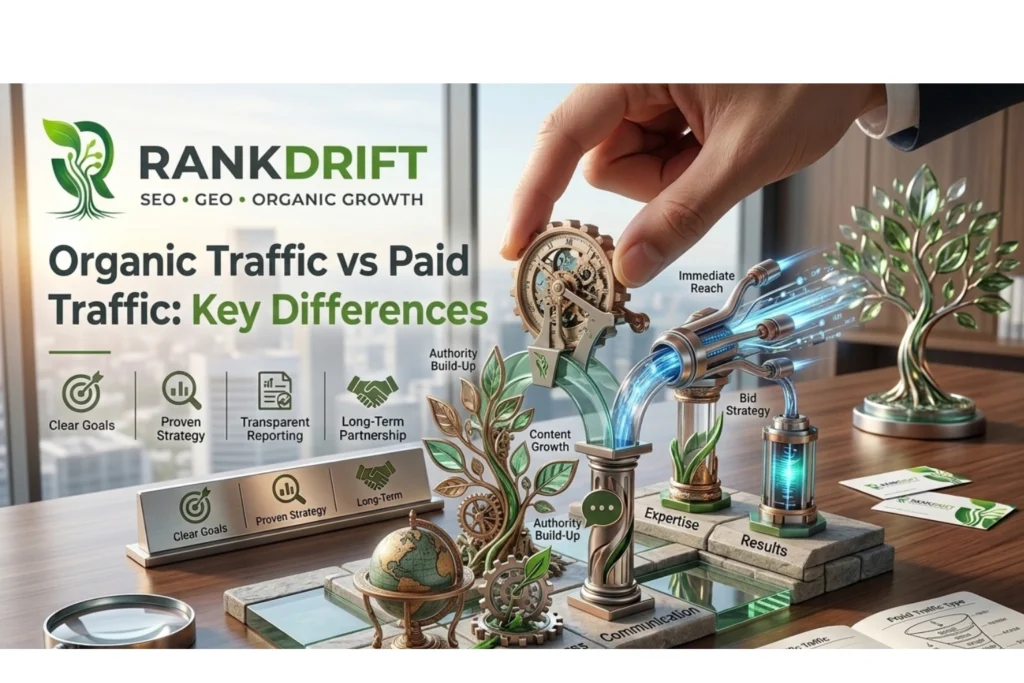
Organic traffic builds lasting search visibility, while paid traffic buys immediate placement through advertising platforms. Both can generate qualified leads, yet their costs, timelines, and long-term value differ significantly. For Indian businesses, the right choice rarely involves selecting only one channel. Instead, success comes from assigning each channel a clear role within the customer journey.
Why Organic Traffic and Paid Traffic Matter Right Now?
Search remains central to how Indian customers evaluate products, services, and brands. According to Think with Google, 64% of Indians research products before purchasing.
The same research found that 83% prefer brands offering trustworthy information. Therefore, businesses must balance immediate visibility with long-term credibility.
Paid campaigns can place your offer before active buyers within hours. However, organic traffic helps customers discover your expertise without requiring payment for every click.
This difference becomes critical when customer acquisition costs rise. Advertising can support quick growth, but relying entirely on ads creates continuous spending pressure.
SEO requires greater patience during the early stages. Still, every useful page can become a reusable acquisition asset.
What Is Organic Traffic?
Organic traffic includes unpaid website visits from search engine results. Users reach your website after searching for information, products, services, or local businesses.
Google follows three primary search stages: crawling, indexing, and serving results. Its systems discover pages, understand their content, and match them with relevant searches.
Google also states that businesses cannot pay for higher organic rankings. This distinction separates SEO visibility from advertising placement. The complete process appears in Google’s Search documentation.
Organic growth usually depends on several connected activities:
- Resolving crawling and indexing problems
- Targeting relevant search terms
- Publishing useful, original content
- Improving page structure and internal links
- Strengthening local search visibility
- Earning authoritative mentions and backlinks
- Improving website usability and performance
Organic results are not automatically free. Your business may invest in writers, developers, SEO specialists, research tools, and digital PR.
However, you do not pay Google whenever someone clicks an organic result. Consequently, a strong page can continue attracting visitors after its production cost ends.
How Long Does Organic Traffic Take to Grow?
SEO rarely produces stable results immediately. Google explains that some improvements may appear within days, while others require several months.
Its systems need time to assess whether a website consistently provides reliable, people-first information. This timeline appears in Google’s guidance on core updates.
A practical SEO timeline may look like this:
| Period | Primary SEO Activity | Likely Outcome |
|---|---|---|
| Month 1 | Audit, tracking, research, technical fixes | Better measurement and crawlability |
| Months 2–3 | Page optimisation and content publishing | Initial indexing and keyword movement |
| Months 4–6 | Content expansion and authority building | More impressions and qualified visits |
| Months 7–12 | Refreshing, consolidation, and scaling | Stronger rankings and compounding growth |
These outcomes remain illustrative, not guaranteed. Competition, website history, resources, and content quality can change the timeline.
What Is Paid Traffic?
Paid traffic includes visits generated through advertisements. Common sources include Google Ads, Meta Ads, LinkedIn Ads, YouTube Ads, and marketplace advertising.
With search advertising, businesses usually bid for exposure around selected queries. They can target users through keywords, locations, devices, audiences, and schedules.
Google defines cost-per-click bidding as paying whenever someone clicks an advertisement. Advertisers can also set a maximum amount for each click. These rules appear in Google Ads Help.
Paid traffic offers speed and control. A properly configured campaign can begin collecting impressions, clicks, and leads shortly after approval.
However, traffic normally falls when the campaign stops spending. Therefore, advertising creates rented visibility rather than an owned search asset.
How Paid Traffic Costs Work?
Your actual advertising expense depends on competition, relevance, targeting, bid strategy, and conversion performance.
Google calculates average CPC using this formula:
Average CPC = Total click cost ÷ Total clicks
For example, imagine an Indian service business spending ₹60,000 monthly. The following figures show how campaign efficiency affects results.
| Metric | Campaign A | Campaign B |
|---|---|---|
| Monthly spend | ₹60,000 | ₹60,000 |
| Average CPC | ₹60 | ₹100 |
| Clicks | 1,000 | 600 |
| Landing-page conversion rate | 5% | 5% |
| Leads | 50 | 30 |
| Cost per lead | ₹1,200 | ₹2,000 |
This example is illustrative. Nevertheless, it shows why traffic volume alone cannot measure advertising success.
Better targeting and landing pages can reduce waste without increasing the budget. Therefore, decision-makers should monitor qualified leads, sales, and acquisition costs.
Organic Traffic vs Paid Traffic: Key Differences
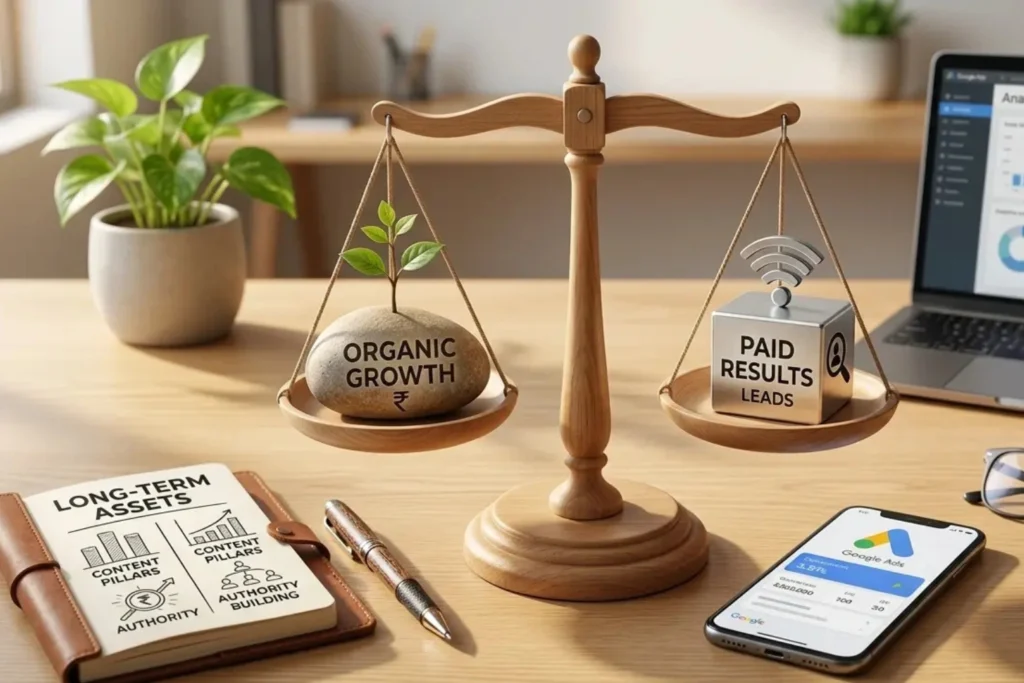
The biggest difference concerns how visibility is earned. Organic traffic comes through relevance and authority, while paid traffic comes through advertising expenditure.
However, speed is not the only consideration. Businesses must also compare sustainability, control, credibility, scalability, and measurement.
| Factor | Organic Traffic | Paid Traffic |
|---|---|---|
| Placement | Unpaid search results | Sponsored advertising positions |
| Initial speed | Usually gradual | Usually immediate |
| Cost model | Investment in people and assets | Payment for clicks or impressions |
| Traffic after spending stops | Can continue | Usually declines quickly |
| Targeting control | Based mainly on search relevance | Detailed audience and campaign controls |
| Testing speed | Slower feedback cycle | Faster testing and optimisation |
| Long-term value | Can compound across months | Depends on continued investment |
| Predictability | Affected by competition and algorithms | Affected by budget, auctions, and policies |
| Best use | Sustainable discovery and authority | Launches, promotions, and rapid demand capture |
Neither channel guarantees profitable results. Organic rankings can fluctuate, while paid campaigns can waste money through poor targeting.
The correct comparison focuses on business outcomes. Track revenue contribution, lead quality, customer acquisition cost, and conversion rate.
Where Organic Traffic Creates Greater Value?
Organic traffic works especially well when customers research extensively before making decisions. Examples include healthcare, education, finance, software, property, and professional services.
It also supports businesses with recurring informational demand. One strong resource can answer customer questions during several buying stages.
Consider a solar installation company targeting commercial buyers. It could publish content covering costs, subsidies, maintenance, savings, and vendor evaluation.
Each page addresses a different concern. Together, those resources establish topical depth and capture demand beyond one commercial keyword.
Google’s SEO Starter Guide recommends making content easier for search engines to crawl, index, and understand. However, Google provides no guarantee of first-place rankings. That clarification appears in its official SEO Starter Guide.
Therefore, your SEO strategy should prioritise useful coverage over unrealistic ranking promises.
Where Paid Traffic Creates Greater Value?
Paid traffic becomes valuable when timing matters more than compounding returns. Examples include product launches, seasonal offers, events, limited inventory, and urgent lead generation.
It also helps new websites lacking established authority. Advertising can test demand while the organic strategy develops.
For example, an Indian interior design company could test separate campaigns for residential and commercial projects. Lead quality would reveal which service deserves greater investment.
Paid campaigns also provide faster feedback on messaging. Your team can compare headlines, offers, locations, and landing pages using measurable outcomes.
However, advertising success requires controlled spending. Google explains that a campaign budget establishes the spending limit for ads. Businesses must also choose suitable bidding options, according to Google Ads guidance.
A large budget cannot rescue weak positioning. Clear offers and strong landing pages remain essential.
Organic Traffic and Paid Traffic Should Share Data
The strongest strategy connects both channels instead of managing them separately. Paid search data can reveal which queries generate conversions quickly.
Your SEO team can use those insights to prioritise valuable landing pages and content clusters. Meanwhile, organic traffic data can identify topics deserving paid promotion.
This relationship creates a practical feedback loop:
- Launch tightly targeted paid campaigns.
- Identify queries producing qualified leads.
- Build useful organic pages around validated demand.
- Retarget visitors who discovered the brand organically.
- compare conversion rates across both channels.
- Reallocate budgets using revenue data.
This approach reduces assumptions. It also prevents SEO and advertising teams from competing for credit.
Google reported that 79% of Indian Gen Z consumers use Google or YouTube daily. The finding came from internal data collected during October 2024. Details appear in Think with Google’s India research.
Therefore, coordinated visibility across search and video can strengthen customer reach.
Common Organic and Paid Traffic Mistakes
1. Treating Organic Traffic as Free Traffic
SEO requires skilled work, consistent production, and technical support. Calling it free hides the resources needed for sustainable performance.
2. Expecting Immediate SEO Results
Some changes produce quick improvements, but durable growth may require months. Short deadlines often encourage weak content and risky shortcuts.
3. Measuring Paid Campaigns Through Clicks Alone
Clicks show interest, not profitability. A campaign needs conversion tracking, lead validation, and revenue attribution.
4. Sending Every Advertisement to the Homepage
A generic homepage may not match the advertisement’s promise. Dedicated landing pages usually create clearer conversion journeys.
5. Targeting Only High-Volume Keywords
Popular keywords can attract irrelevant visitors. Lower-volume searches often express stronger buying intent and specific requirements.
6. Stopping SEO After Rankings Improve
Competitors continue publishing and optimising. Existing pages also become outdated, so consistent maintenance protects organic traffic performance.
7. Keeping SEO and Advertising Teams Separate
Disconnected teams duplicate research and miss valuable insights. Shared search-term and conversion data improves both strategies.
Practical Traffic Strategy Checklist
Use this checklist before deciding how much to invest in each channel.
- Define one primary commercial outcome. Choose qualified leads, online sales, bookings, or revenue.
- Confirm reliable tracking. Configure analytics, advertising conversions, forms, calls, and CRM stages.
- Calculate acceptable acquisition costs. Include gross margins, sales close rates, and customer lifetime value.
- Map search intent. Separate informational, comparison, commercial, branded, and local searches.
- Audit existing visibility. Review indexed pages, rankings, paid activity, and competitor coverage.
- Use paid traffic for urgent demand. Prioritise launches, promotions, and high-intent commercial searches.
- Build organic traffic around recurring demand. Create pages that answer lasting customer questions.
- Test landing pages continuously. Improve headlines, proof, offers, forms, and calls to action.
- Review lead quality monthly. Cheap leads offer little value when sales teams cannot convert them.
- Compare blended performance quarterly. Measure total search investment against revenue from all search channels.
A practical budget should reflect your current growth stage. New businesses may initially favour paid acquisition while building their SEO foundation.
Established brands can invest more heavily in organic traffic while retaining paid campaigns for priority offers.
Frequently Asked Questions
Is organic traffic better than paid traffic?
Organic traffic offers stronger long-term sustainability, while paid traffic provides faster visibility. The better option depends on your timeline, budget, and objectives.
Does organic traffic cost nothing?
No. Businesses invest in content, SEO expertise, website improvements, research, and authority development. However, they do not pay per organic click.
How quickly can paid traffic generate leads?
Campaigns can generate visits shortly after approval. Lead quality depends on targeting, messaging, landing pages, competition, and conversion tracking.
Should a small Indian business invest in both channels?
Usually, yes. Start with focused paid campaigns for immediate demand while developing a realistic SEO programme for sustainable discovery.
Can paid advertising improve organic rankings?
Paying for advertisements does not directly improve organic rankings. However, campaign data can reveal valuable queries, offers, and audience behaviour.
Final Thought
The smartest decision is not choosing organic traffic or paid traffic permanently. Use paid campaigns to capture and test demand now. Meanwhile, build organic assets that reduce dependence on continuous advertising. When both channels share data, your search strategy becomes faster, stronger, and more resilient.