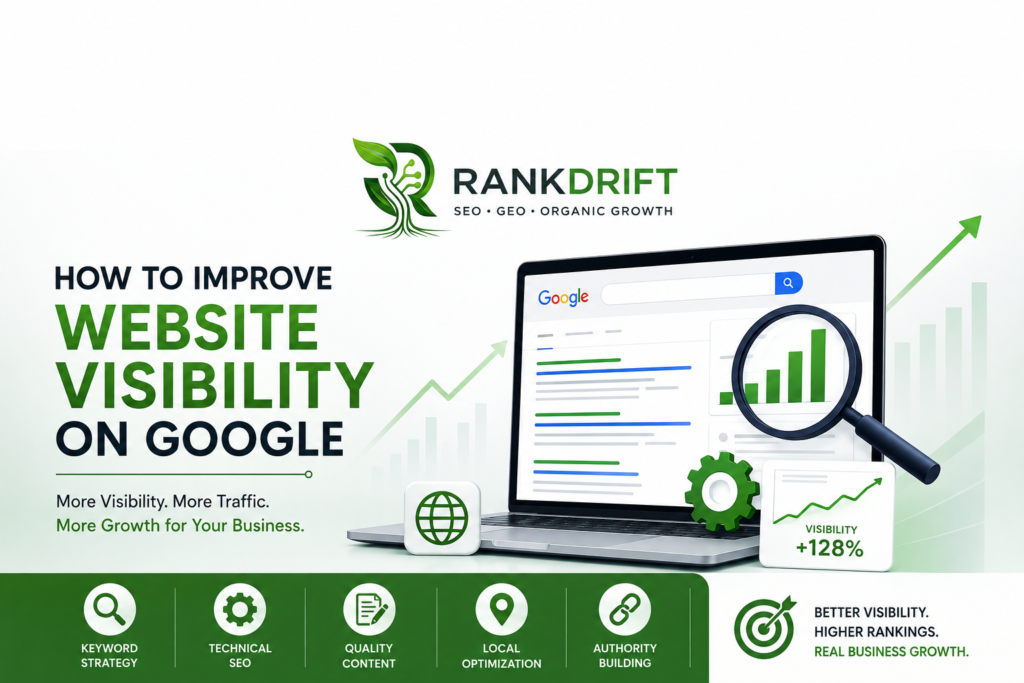
A website can be technically live, beautifully designed, and still remain almost invisible on Google. Google says its systems automatically discover most pages through crawling, but being online does not guarantee that a page will be crawled, indexed, or shown for the searches that matter to your business.
Improving Website Visibility on Google means making your website easier to discover, understand, trust, and choose across relevant searches—not simply adding more keywords to your pages.
Why Website Visibility on Google Matters More Than Just Ranking
Search visibility is broader than having one page rank for one keyword. Your business can appear through organic listings, local results, images, structured search features, and increasingly through Google’s AI-powered search experiences.
Google’s current guidance confirms that the same foundational SEO practices remain relevant for AI Overviews and AI Mode. There are no special technical requirements specifically for AI features; your pages still need to meet Google’s normal technical and content requirements.
That changes how businesses should measure SEO.
| Visibility Area | What It Helps You Capture | Priority |
|---|---|---|
| Organic Search | Informational and commercial searches | High |
| Local Search | Nearby customers and service searches | High |
| Google Images | Visual discovery | Medium |
| Rich Results | Enhanced search appearances | Medium |
| AI Search Features | AI-assisted discovery and supporting links | Growing |
| Branded Search | People already looking for your business | High |
For an Indian business, this is especially important when customers search using combinations of service + city, product terms, problem-based queries, and comparison searches.
RankDrift approaches visibility as a broader search-growth problem rather than treating one keyword position as the entire SEO strategy.
1. Start With Technical SEO Before Chasing Rankings
Google needs to be able to access, crawl, understand, and index your pages before those pages can compete in search.
Google’s Search Essentials specifically separates technical requirements from spam policies and recommended best practices. Meeting those requirements does not guarantee rankings, but failing to meet them can prevent pages from performing properly.
Start by checking the fundamentals:
- Can Googlebot access important pages?
- Are important URLs indexed?
- Are there accidental
noindextags? - Is the robots.txt file blocking useful content?
- Does the XML sitemap contain the right URLs?
- Are canonical tags correctly implemented?
- Are broken links creating unnecessary dead ends?
- Does the mobile version contain the same important content?
Google’s crawling documentation recommends logical URL structures and XML sitemaps to help Google discover new or updated pages.
Technical Problems vs Visibility Impact
| Technical Issue | Possible Visibility Problem | What to Check |
|---|---|---|
noindex on important page | Page may not appear in Google | Page source / Search Console |
| Broken internal links | Crawlers and users may struggle to reach content | Internal link audit |
| Poor sitemap | Important URLs may be harder to discover | XML sitemap |
| Duplicate URLs | Signals can become fragmented | Canonicals |
| Slow page experience | Can hurt usability and overall performance | PageSpeed Insights |
| Mobile content mismatch | Important content may not be available to mobile users | Mobile version |
Google also states that it does not accept payment to crawl a website more frequently or rank it higher.
So if someone promises guaranteed Google rankings simply by paying for faster crawling, that’s a major warning sign.
2. Build Content Around Search Intent, Not Just Keywords
A common SEO mistake is creating a page because a keyword has search volume.
Search volume tells you that people search for something. It does not automatically tell you what they expect to find.
For example, someone searching for:
“SEO agency in Delhi”
has a very different intent from someone searching:
“what is SEO”
The first query is commercial and potentially close to a buying decision. The second is primarily informational.
Your website should reflect those differences.
Match the Page to the Search
| Search Intent | Example Query | Suitable Page |
|---|---|---|
| Informational | What is technical SEO? | Blog / Guide |
| Commercial | Best SEO agency in India | Service comparison / Agency page |
| Transactional | Hire SEO agency | Service / Lead page |
| Local | SEO agency near me | Local landing page |
| Navigational | RankDrift SEO agency | Brand page |
Google’s people-first content guidance emphasizes creating content that provides substantial, useful information for people rather than content primarily designed to manipulate rankings.
That means your target keyword should be the starting point not the entire content strategy.
A strong page answers the actual question behind the search.
For example, a service page targeting SEO services in India should not simply repeat the phrase throughout the page. It should explain services, process, reporting, suitable business types, expected timelines, deliverables, and the questions a potential client needs answered before contacting an agency.
3. Improve On-Page Signals Without Keyword Stuffing
Once technical foundations and search intent are clear, optimize the page itself.
Your title tag should communicate what the page offers. The main heading should establish the topic clearly, while subheadings should organize the information into logical sections.
Google’s search appearance documentation explains that website owners can influence how their pages appear through elements such as title links, snippets, structured data, images, and other search features.
A practical on-page structure looks like this:
Title: How to Improve Website Visibility on Google
H1: How to Improve Website Visibility on Google
H2: Technical SEO Foundations
H2: Search Intent and Keyword Strategy
H2: Content and Internal Linking
H2: Local SEO and Google Business Profile
This structure makes the page easier for users to scan and gives search engines clearer contextual signals.
Don’t Ignore Internal Linking
Internal links connect related pages and help users move deeper into your website.
Suppose RankDrift publishes an article about website visibility. That article can naturally link to relevant pages covering technical SEO, link building, local SEO, GEO, and SEO services.
The goal is not to add dozens of links.
The goal is to create a useful information path:
Blog → Related Guide → Service Page → Contact / Conversion
This helps turn search traffic into business opportunities rather than leaving visitors on isolated blog posts.
4. Use Structured Data Where It Actually Fits
Structured data gives Google additional information about the meaning of a page.
Google explains that structured data can help its systems understand page content and can make pages eligible for certain enhanced search appearances.
It is important to understand the difference between eligibility and guaranteed appearance.
Adding schema does not guarantee a rich result.
Google explicitly says that even correctly implemented structured data does not guarantee that the corresponding search feature will appear.
For example:
| Website Element | Potential Structured Data |
|---|---|
| Blog article | Article |
| Business | Organization / LocalBusiness |
| Product page | Product |
| Breadcrumbs | BreadcrumbList |
| Event page | Event |
| FAQ content | FAQ-related structured data where applicable |
Google’s documentation also provides real implementation case studies. For example, Google reports that Rotten Tomatoes measured a 25% higher click-through rate on pages enhanced with structured data compared with pages without it.
The lesson is simple: use structured data to accurately describe your content, not as a shortcut for rankings.
5. Local SEO Can Increase Visibility for Location-Based Searches
If your business serves a specific city, region, or physical location, local SEO should be part of your visibility strategy.
Google says local results are primarily influenced by relevance, distance, and prominence. It also recommends keeping Business Profile information complete and accurate.
That means a local business should pay attention to:
- Google Business Profile accuracy
- Business name, address, and phone consistency
- Relevant business categories
- Service and location information
- Customer reviews
- Local landing pages
- Relevant mentions and links from other websites
Google also notes that prominence can be influenced by information such as links from other websites and reviews.
For example, an SEO agency targeting customers in Delhi should not rely exclusively on a generic “SEO Services” page. Location-specific content and a properly maintained Business Profile can help establish stronger relevance for local searches.
6. Make Your Website Useful for Google’s AI Search Experiences
Google’s AI Overviews and AI Mode are changing how people interact with search.
But Google does not recommend creating a completely separate “AI SEO” system. Its current documentation says the foundational SEO best practices remain applicable to AI features. Pages need to be indexed and eligible to appear in normal Google Search before they can be supporting links in these experiences.
This makes strong fundamentals even more important.
Write content that provides:
- Clear answers
- Original information
- Useful examples
- Specific explanations
- Logical structure
- Supporting evidence
- Clear relationships between topics
Google says AI Overviews and AI Mode may use multiple related searches to develop responses and identify supporting pages.
In June 2026, Google also announced new Search Console reporting for visibility from generative AI features, initially rolling it out to a subset of websites.
For marketers, that means visibility measurement is gradually becoming broader than traditional blue-link rankings.
Common Mistakes That Reduce Website Visibility
Publishing dozens of low-value pages
More pages do not automatically mean more traffic. If pages provide little original value or exist primarily to target slightly different keyword variations, they may add very little to your search presence.
Focusing only on one keyword
A business can rank for hundreds of relevant search queries from a well-structured page. Building content around topics and intent is generally more useful than repeating one exact phrase.
Ignoring indexing
You cannot improve the ranking of a page that Google cannot properly access or index.
Treating backlinks as the entire SEO strategy
Links can contribute to authority and prominence, but technical accessibility, relevance, content quality, and user experience still matter.
Forgetting local search
If customers search for your services by city or location, ignoring Google Business Profile and local signals leaves an important visibility channel underdeveloped.
A Practical Website Visibility Checklist
Use this checklist before investing heavily in more content.
- Check indexing: Review Google Search Console for indexed and excluded pages.
- Audit technical SEO: Check redirects, broken links, canonicals, robots.txt, sitemap, and mobile accessibility.
- Map search intent: Connect important keywords to the correct page type.
- Improve titles and headings: Make every important page immediately understandable.
- Strengthen content: Add original information, examples, evidence, and answers.
- Build internal links: Connect related articles, service pages, and commercial pages.
- Improve local presence: Keep your Google Business Profile complete and accurate.
- Add relevant structured data: Implement only schema that accurately represents the page.
- Build authority: Earn relevant mentions and links rather than relying on manipulative tactics.
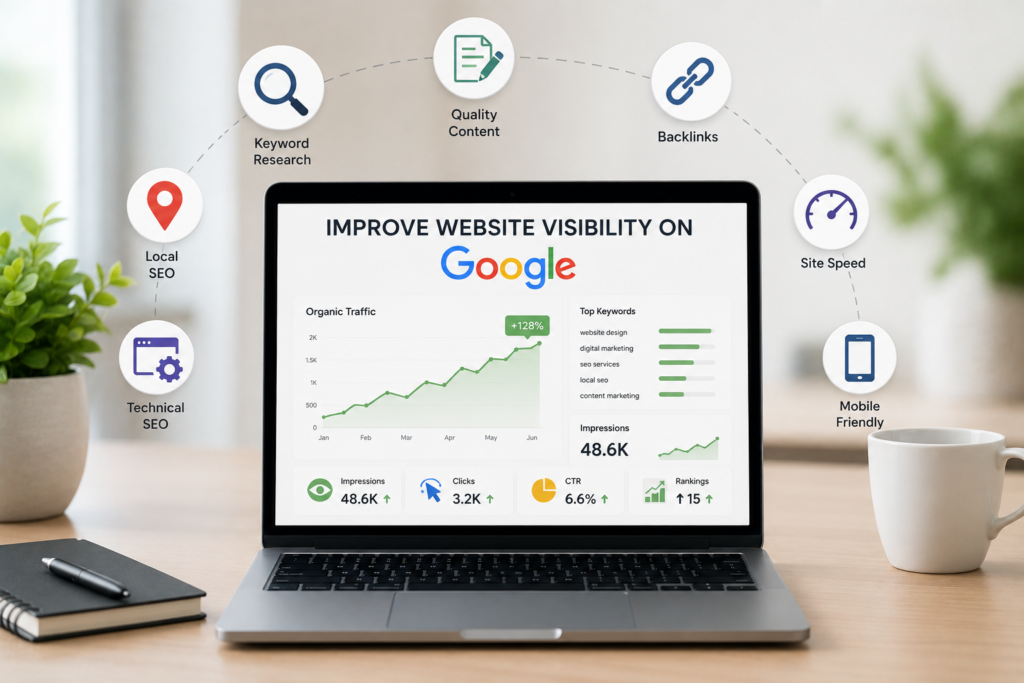
- Measure business outcomes: Track impressions, clicks, qualified traffic, leads, and conversions—not rankings alone.
What to Measure
| Metric | What It Tells You |
|---|---|
| Impressions | How often Google shows your pages |
| Clicks | How much search traffic you receive |
| CTR | How effectively search appearances attract clicks |
| Indexed pages | Whether Google can include your content |
| Organic conversions | Whether visibility produces business value |
| Local actions | Whether local searchers engage |
| AI visibility | Exposure through eligible generative search features |
Google Search Console remains a core diagnostic tool for understanding how Google crawls and indexes your website and how your pages perform in Search.
FAQ: Improving Website Visibility on Google
How long does it take to improve website visibility on Google?
There is no universal timeline. Technical fixes can sometimes produce changes relatively quickly, while competitive keywords, authority building, and content growth can require substantially more time. Google also does not guarantee that a page will rank simply because SEO best practices have been followed.
What is the fastest way to improve website visibility?
Start with problems that can prevent visibility entirely: indexing issues, blocked pages, incorrect canonicals, broken important URLs, and poor internal linking. Once those are addressed, focus on search intent, content quality, local SEO, and authority.
Does adding more keywords improve Google rankings?
Not necessarily. Google emphasizes helpful, reliable, people-first content rather than content created primarily to manipulate rankings.
Does structured data improve rankings?
Structured data can help Google understand page content and may make pages eligible for enhanced search appearances, but it is not a guarantee of higher rankings or rich-result visibility.
Does SEO help with Google’s AI search features?
Yes, the same foundational SEO practices remain relevant. Google states that pages need to meet normal technical requirements and be eligible for Google Search before they can appear as supporting links in AI Overviews or AI Mode.
The Takeaway
Better Website Visibility on Google comes from fixing the entire search journey: make your site crawlable, build pages around real search intent, publish genuinely useful content, strengthen internal and external signals, and measure what actually contributes to business growth.
If your website is getting impressions but not enough clicks or leads, the problem may not be “more SEO.” It may be the gap between being visible and being relevant enough to choose.
RankDrift helps businesses strengthen that gap through SEO, GEO, and organic growth strategies built around measurable search visibility.