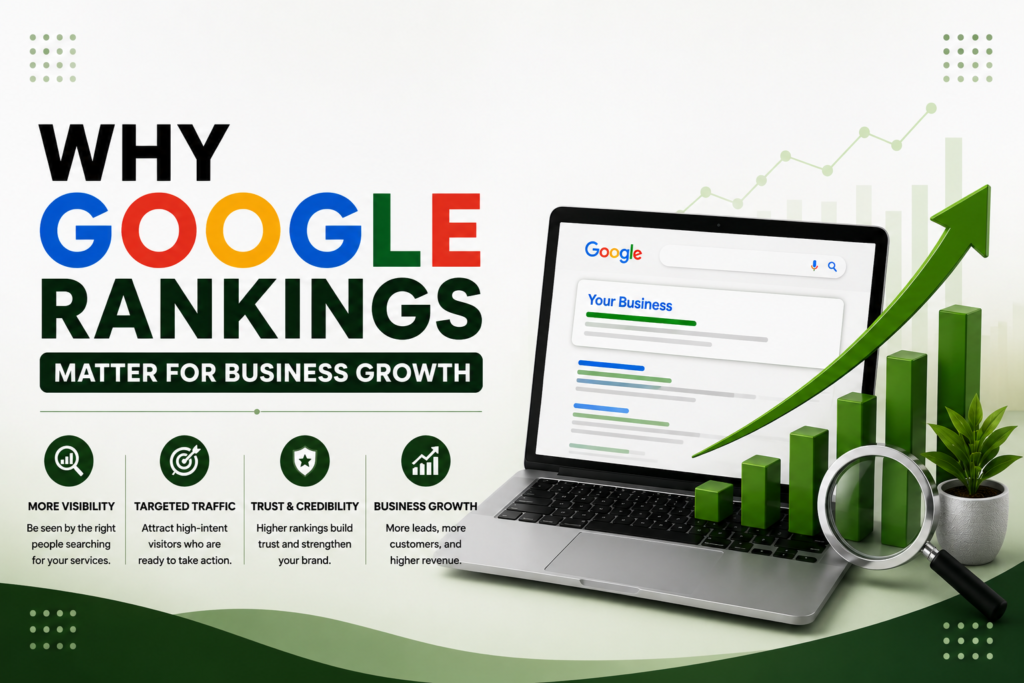
Google rankings are not just an SEO metric. They determine how easily potential customers can find your business when they are actively searching for a product, service, or solution you provide.
Google says its ranking systems evaluate hundreds of billions of web pages and use many signals to return relevant and useful results in a fraction of a second. For a business, that means visibility in search can directly influence how many people enter your marketing funnel.
Why Google Rankings Matter More Than Ever
A customer rarely starts with a brand name. They often start with a problem.
Someone may search for best digital marketing agency in Delhi, SEO services for small businesses, dentist near me, or best accounting software for startups. If your website does not appear where that customer is looking, another business gets the opportunity.
This is where Google rankings become a business-growth asset rather than simply a technical SEO goal.
BrightEdge research published in 2025 found that organic search remained the primary driver of referral traffic and delivered stronger conversions than AI search referrals in its dataset, even as AI-driven discovery grew rapidly.
For businesses, the takeaway is simple: SEO is still important for capturing demand that already exists.
Rankings influence the customer journey
A strong organic presence can support several stages of the buying process:
| Customer stage | Search behaviour | SEO opportunity |
|---|---|---|
| Awareness | “What is SEO?” | Educational content |
| Research | “Best SEO agency for small business” | Service and comparison pages |
| Evaluation | “RankDrift SEO services” | Brand, case studies and proof |
| Decision | “SEO agency in India” | Service + local SEO pages |
| Action | “SEO consultation” | Landing pages and conversion elements |
The important point is that ranking for one keyword is not enough. Your website needs visibility across the searches your potential customers make before they contact you.
Higher Rankings Can Put Your Business in Front of High-Intent Customers
Not all website traffic has the same value.
A person searching what is SEO is usually at an earlier stage than someone searching SEO agency for small business. Both searches matter, but the second indicates stronger commercial intent.
This is why a good SEO strategy does not simply chase high-volume keywords. It connects search intent with business goals.
Search intent should guide your SEO strategy
Consider these examples:
- Informational: “How does local SEO work?”
- Commercial: “Best local SEO agency”
- Transactional: “Buy SEO package”
- Navigational: “RankDrift SEO agency”
Each query requires a different type of page.
Google explains that its systems consider relevance and many other signals when determining which results to show for a query.
So instead of asking only, “What keyword should I rank for?”, ask:
“What does the person searching this keyword actually want to accomplish?”
That shift can improve both rankings and conversions.
Google Rankings Build Visibility Without Paying for Every Click
Paid advertising can generate immediate visibility, but the traffic generally depends on continued advertising spend.
SEO works differently. You invest in improving your website, content, technical foundation and authority so that relevant pages can earn organic visibility.
That does not make SEO free. SEO requires investment in strategy, content, technical work, tools and ongoing optimisation. The difference is how the traffic acquisition model works.
| SEO | Paid Search |
|---|---|
| Organic visibility | Sponsored visibility |
| Requires ongoing optimisation | Requires ongoing ad budget |
| Can build long-term search presence | Can generate immediate visibility |
| Content and authority are important | Bid, budget and ad relevance are important |
| Traffic does not require a payment for every organic click | Advertiser pays when users interact according to the campaign model |
For many businesses, the strongest approach is not SEO vs advertising. It is using both strategically.
Paid campaigns can support short-term demand generation while SEO builds an organic asset that continues working beyond a single campaign.
Rankings Are Connected to Trust and Brand Visibility
When your business repeatedly appears for relevant searches, customers have more opportunities to encounter your brand.
That does not mean users automatically trust every website on page one. Your search presence still needs to be supported by useful content, clear information, reviews where appropriate, strong branding and a credible website experience.
Google’s guidance specifically emphasises helpful, reliable, people-first content rather than content created primarily to manipulate rankings.
Ranking visibility + strong website = stronger opportunity
Think of the relationship like this:
Search visibility → Website visit → Trust → Enquiry → Customer
If your website is invisible, the process often stops before the first step.
If your website ranks but provides a poor experience, traffic may not turn into business.
That is why SEO should be measured beyond rankings alone.
Rankings Should Be Measured Against Business Results
One of the biggest mistakes businesses make is treating position as the final goal.
Ranking #1 for a keyword that produces no relevant leads may have little business value. Meanwhile, ranking in the top results for several highly relevant commercial searches could produce meaningful enquiries.
A better SEO measurement framework looks at several levels.
| SEO metric | What it tells you | Business relevance |
|---|---|---|
| Keyword rankings | Search visibility | Awareness |
| Organic impressions | How often pages appear | Market reach |
| Organic clicks | Website visits from search | Traffic |
| Engagement | What visitors do on site | Quality of traffic |
| Leads | Enquiries generated | Direct business value |
| Conversions | Customers or sales | Revenue impact |
Google Search Console can help businesses monitor search performance, including impressions and clicks. Analytics and CRM data can then help connect website activity with leads and customers.
A simple example
Imagine an Indian service business receives:
- 10,000 monthly search impressions
- 500 organic visits
- 30 enquiries
- 8 new customers
If SEO improvements increase relevant visibility and organic traffic, the real goal is not simply “more rankings.”
The goal is to create more qualified opportunities.
That distinction is important when evaluating an SEO agency or internal SEO team.
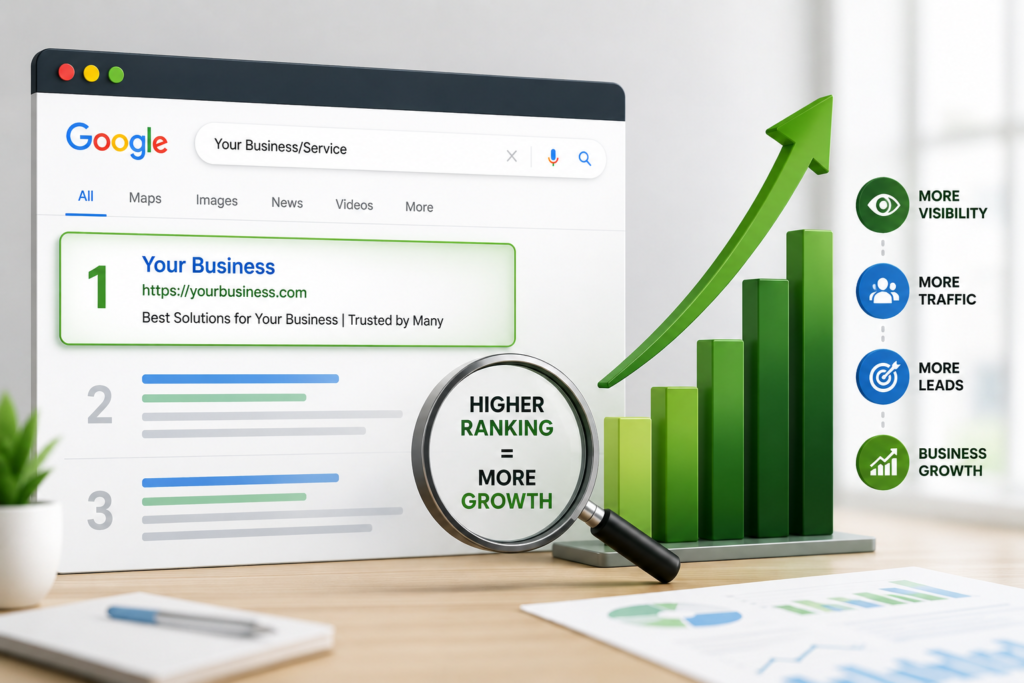
Technical SEO Still Matters to Rankings
Strong content cannot compensate for every technical problem.
Google’s search process involves crawling, indexing and serving results. If important pages cannot be properly crawled or indexed, their ability to appear in search can be limited.
Technical SEO therefore provides the foundation for organic visibility.
Areas worth checking include:
- Website crawlability
- Indexing problems
- Mobile usability
- Page speed
- Internal linking
- Canonical URLs
- XML sitemap
- Robots.txt
- Broken links
- HTTPS
- Structured data where appropriate
The objective is not to make your website technically complicated. It is to make it easier for both users and search engines to understand and access.
Content Quality Can Strengthen Your Search Position
Publishing dozens of articles does not automatically create rankings.
Google’s guidance recommends content that is helpful, reliable, original and created primarily for people. It also encourages demonstrating first-hand expertise and providing substantial value rather than producing content simply to attract search traffic.
For a business, this means your content should answer questions your actual customers have.
Instead of publishing:
“10 Benefits of SEO”
create something more useful, such as:
“How Much Does SEO Cost for a Small Business in India?”
The second topic can address pricing factors, business size, competition, timelines, deliverables and realistic expectations.
That is content a potential buyer can actually use.
Google Rankings Are Also Changing With AI Search
The search experience is no longer limited to traditional blue links.
Google continues to introduce AI-powered search experiences, while customers increasingly use AI tools to research businesses, products and services.
BrightEdge reported in 2025 that AI search referrals were growing rapidly but still represented less than 1% of referral traffic in its dataset, while organic search remained a major traffic and conversion channel.
This does not mean businesses should abandon traditional SEO.
It means your SEO strategy should become broader.
Traditional SEO and AI visibility should work together
| Traditional SEO focus | AI-era opportunity |
|---|---|
| Search rankings | Search + AI visibility |
| Keyword targeting | Search intent and entities |
| Backlinks | Authority and credible mentions |
| Blog content | Useful, structured answers |
| Technical SEO | Crawlable, accessible content |
| Brand searches | Consistent brand information |
| Organic traffic | Traffic + visibility across discovery channels |
RankDrift can approach SEO with this wider perspective: build strong organic foundations while preparing content and brand signals for changing search behaviour.
Common Mistakes Businesses Make With Google Rankings
1. Chasing only high-volume keywords
A keyword with 50,000 searches is not automatically better than one with 500 searches.
If the smaller keyword attracts customers who are ready to buy, it may have greater commercial value.
2. Expecting results overnight
SEO is not normally a switch you turn on today and measure tomorrow.
Pages need to be crawled, indexed, evaluated and compete against existing results. Google itself states that it does not guarantee that pages will be crawled, indexed or served in search results.
3. Publishing content without a strategy
More content is not necessarily better.
Each page should have a clear purpose, target audience and search intent.
4. Ignoring conversion optimisation
Getting visitors to your website is only part of the job.
If visitors cannot quickly understand what you offer or how to contact you, rankings may produce traffic without enough business value.
5. Measuring rankings alone
Position should be one metric in your reporting not the entire report.
Practical SEO Actions for Better Google Visibility
If your business wants to turn search rankings into measurable growth, start with these steps:
1. Identify your highest-value searches
List the products, services and problems your customers search for. Group keywords according to intent instead of treating every phrase equally.
2. Audit your existing rankings
Use Google Search Console to identify pages already receiving impressions and clicks. Look for opportunities where a small improvement could produce additional visibility.
3. Improve important landing pages
Review your service pages for:
- Clear search intent
- Strong page titles
- Useful headings
- Original content
- Relevant internal links
- Clear calls to action
- Trust signals
4. Fix technical barriers
Check indexing, crawlability, broken links, mobile usability, site speed and other technical issues.
5. Build useful content around customer questions
Create guides, comparisons, FAQs and problem-solving content that supports your audience throughout the buying journey.
6. Strengthen authority
Earn relevant backlinks, mentions and citations from credible websites. Google’s ranking systems continue to include link analysis among the systems used to understand pages.
7. Track business outcomes
Connect organic traffic with enquiries, calls, form submissions and sales wherever possible.
That is how SEO moves from a marketing activity to a measurable growth channel.
FAQ
Why do Google rankings matter for businesses?
Google rankings matter because they determine how prominently your website can appear when potential customers search for relevant products, services and information. Better visibility can create more opportunities for qualified website traffic and enquiries.
Is ranking #1 on Google necessary?
No. The goal is not to rank #1 for every keyword. A stronger strategy focuses on achieving valuable visibility for relevant searches that align with your customers and business objectives.
How long does it take to improve Google rankings?
There is no universal timeline. Results depend on competition, website condition, content quality, authority, technical issues and the search queries being targeted. Google does not guarantee specific rankings or indexing timelines.
Can small businesses compete with larger companies in Google Search?
Yes. Smaller businesses can compete by focusing on specific services, locations, customer problems and niche topics where they can demonstrate genuine expertise and relevance.
Does SEO still matter with AI search?
Yes. AI search is changing how people discover information, but organic search remains a major source of website visibility. Businesses should strengthen their traditional SEO foundation while making their content clear, useful, authoritative and easy for modern search systems to understand.
The Business Value of Being Visible
Google rankings matter because they put your business in front of people who are already expressing interest through search.
The most valuable SEO strategy is not the one that produces the biggest ranking report. It is the one that connects search visibility with qualified traffic, enquiries and revenue.
For businesses planning sustainable organic growth in 2026, RankDrift can help turn search visibility into a structured growth strategy starting with the searches that matter most to your customers.