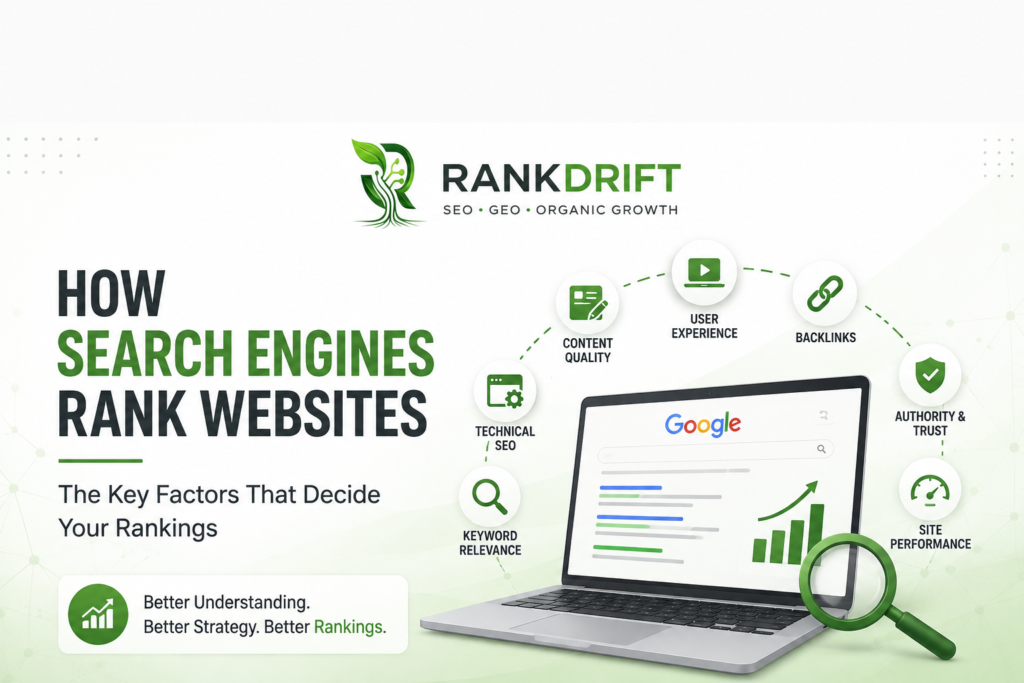
Google processes billions of pages to return results that best match what a user is looking for. But ranking is not based on one factor such as keywords, backlinks, or website speed. Google says its ranking systems use many signals and systems to determine which pages are relevant and useful for a particular query.
For businesses, this means SEO is less about finding a single “ranking trick” and more about making your website easy to discover, understand, trust, and use.
Why Understanding Search Rankings Matters for Businesses
A website can have excellent products or services and still struggle to appear prominently in search results if search engines cannot properly crawl, understand, or evaluate its pages.
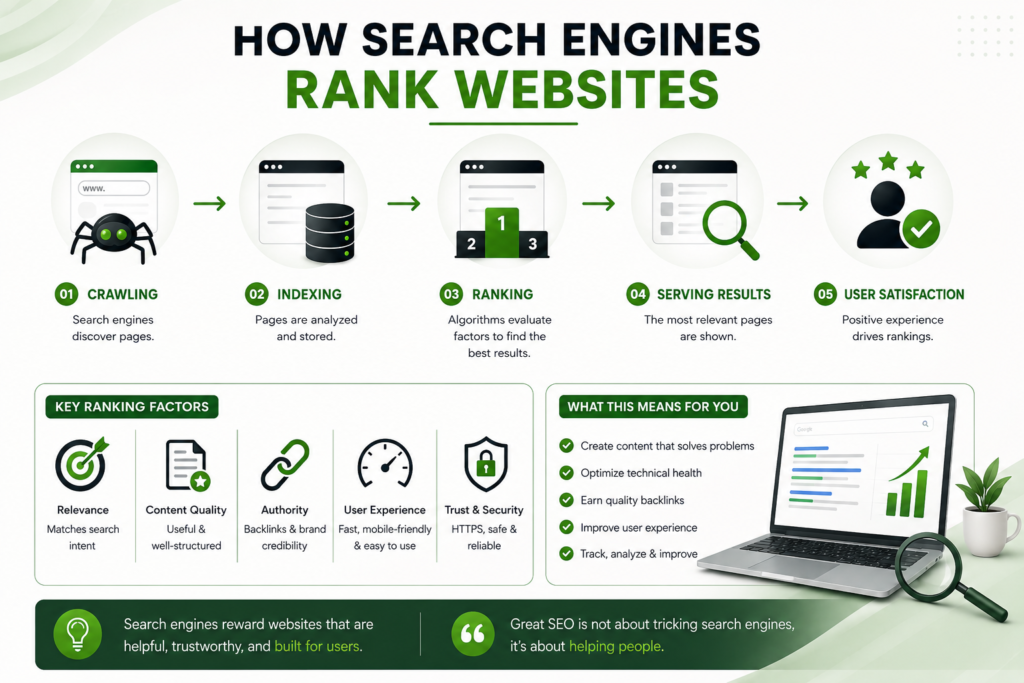
Google describes Search as a three-stage process: crawling, indexing, and serving search results. A page has to get through these stages before it can compete for visibility.
This distinction is important because many businesses jump straight into keyword optimization without checking whether search engines can actually access their website.
| Stage | What happens | What businesses should focus on |
|---|---|---|
| Crawling | Search engines discover and access pages | Internal links, sitemap, technical accessibility |
| Indexing | Search engines analyze and store page information | Content, titles, canonical URLs, metadata |
| Ranking | Systems determine which results best satisfy the query | Relevance, quality, usefulness, authority, context |
| Serving | Results are presented based on the user’s search | Intent, location, language, device, search features |
Google also makes an important distinction: being indexed does not guarantee that a page will rank or even appear for a particular search. Relevance and quality still determine whether it is competitive.
For a business working with RankDrift, this is why SEO should begin with the entire search journey rather than simply adding keywords to pages.
1. Search Engines First Need to Discover Your Website
Before Google can rank a page, it needs to know that the page exists.
Googlebot discovers URLs through links, sitemaps, previously known pages, and other discovery mechanisms. Google explains that there is no central registry of every webpage on the internet, so crawlers continuously discover new and updated content.
This makes website architecture an important part of SEO.
Suppose you publish a new service page but never link to it from your navigation, relevant service pages, blog posts, or other accessible pages. Even if the page is technically live, its discoverability may be weaker.
A clean internal linking structure helps search engines understand which pages matter and how different topics on your website relate to each other.
What to check
Your website should have:
- A logical URL structure
- Internal links connecting related pages
- An XML sitemap
- No accidental
noindexdirectives on important pages - Crawlable navigation
- Working pages without unnecessary technical barriers
- Proper redirects when URLs change
Google’s Search Essentials identifies technical requirements as the minimum foundation needed for pages to be eligible to appear in Search.
Key point: SEO cannot compensate for a page that search engines cannot properly access or process.
2. Indexing Determines What Search Engines Understand
Crawling only means Google has accessed a page. Indexing is the next step.
During indexing, Google analyzes the content, images, videos, title elements, alt attributes, and other information associated with a page. It may also identify duplicate versions and select a canonical page to represent similar URLs.
This is where content structure becomes particularly important.
Consider two service pages:
Page A:
“SEO services designed to improve your website’s visibility through technical optimization, content strategy, keyword research, local SEO, and authority building.”
Page B:
“Best SEO services. We provide SEO. SEO is important for businesses. Contact us for SEO.”
Both pages contain the word “SEO,” but they do not provide the same level of information or context.
Search engines increasingly rely on language understanding rather than simply counting exact keyword occurrences. Google’s SEO Starter Guide explains that its language-matching systems can understand how a page relates to different searches even when the exact wording is not present.
Build pages around topics, not keyword repetition
A strong page should clearly communicate:
- What the page is about.
- Who it is intended for.
- What problem it solves.
- What information or service it provides.
- Why the reader should trust the information.
- What the reader should do next.
| Weak optimization | Strong optimization |
|---|---|
| Repeating the exact keyword | Covering the complete search topic |
| Generic 500-word service copy | Specific, useful information |
| Writing for algorithms | Writing for the intended customer |
| Multiple pages targeting the same intent | Clear keyword and intent mapping |
| Copying competitor topics | Adding original expertise and value |
Google’s current guidance specifically recommends creating helpful, reliable, people-first content rather than content primarily designed to manipulate rankings.
3. Relevance Is One of the Biggest Ranking Questions
Once a page can be crawled and understood, search engines need to determine whether it actually answers the user’s query.
Imagine someone searches:
“SEO agency for small businesses in Delhi.”
A page titled “Digital Marketing Trends” may mention SEO, but it does not necessarily satisfy that intent.
A dedicated page explaining SEO services for small businesses, the problems those businesses face, relevant processes, service areas, examples, and next steps is much more closely aligned with the query.
Google explains that search results are determined using hundreds of factors, including signals related to the user’s query, location, language, and device.
That means the same business may perform differently for different searches.
Search intent changes the ranking opportunity
| Search intent | Example query | Suitable page |
|---|---|---|
| Informational | What is technical SEO? | Educational article |
| Commercial | Best SEO agency for startups | Comparison/service content |
| Transactional | Hire SEO agency | Service or contact page |
| Local | SEO agency in Mumbai | Local/service landing page |
| Navigational | RankDrift SEO agency | Brand page |
A common SEO mistake is trying to make one page rank for every variation of a topic.
Instead, build pages around distinct search intents and connect them through internal links.
This is also where RankDrift can approach SEO strategically: keyword research should not simply produce a list of terms. It should help determine which pages deserve to exist and what each page needs to accomplish.
4. Quality and Usefulness Influence Ranking
Search engines have an enormous amount of content to choose from. Simply publishing a page does not make it competitive.
Google’s guidance says its automated systems aim to prioritize helpful, reliable information created primarily to benefit people. It recommends evaluating whether content provides original information, substantial value, insightful analysis, and evidence of expertise.
That changes how businesses should approach content marketing.
Instead of asking:
“How many blog posts should we publish this month?”
Ask:
“What useful information can our business provide that customers cannot easily get from a generic article?”
For example, a local accounting firm could publish a generic article titled “What Is GST?” Hundreds of websites already cover the subject.
A more valuable resource might explain common GST filing mistakes made by small businesses in India, supported by examples, official references, practical explanations, and expert commentary.
The second approach gives the business an opportunity to demonstrate first-hand knowledge.
Originality matters
Google’s guidance specifically asks whether content provides original information, research, reporting, or analysis and whether it adds substantial value instead of simply rewriting other sources.
That means businesses should avoid building their entire content strategy around rewriting competitors.
Better approach:
Research → add expertise → provide examples → support claims → answer related questions → improve usability.
This creates content that is useful to customers before it is useful to search engines.
5. Authority and Trust Help Search Engines Evaluate Pages
Relevance tells search engines whether a page matches a query. Quality and trust help determine whether the page deserves to compete.
Google discusses E-E-A-T — Experience, Expertise, Authoritativeness, and Trustworthiness in its content guidance. Google also clarifies that E-E-A-T itself is not a single ranking factor. Instead, its systems use a variety of signals that can identify content demonstrating these qualities.
For businesses, this can be demonstrated through practical signals such as:
- Clear author information
- Relevant credentials or experience
- Original research and examples
- Transparent business information
- Reliable external references
- Strong editorial standards
- Helpful About and contact pages
- Relevant mentions and links from reputable websites
Backlinks can also contribute to how search engines understand a website’s authority, but quality matters more than simply collecting large numbers of links.
A hundred irrelevant links from low-quality websites are not equivalent to a small number of genuinely relevant references from respected sources.
6. Page Experience Supports Search Performance
A page can contain excellent information and still provide a poor experience.
Slow loading, difficult navigation, intrusive elements, confusing layouts, or poor mobile usability can make it harder for visitors to consume the information.
Google says its core ranking systems consider signals related to page experience, while also emphasizing that relevance remains critical.
The practical lesson is not to chase one technical score at the expense of everything else.
| Priority | What to improve |
|---|---|
| Content | Accuracy, usefulness, originality |
| Technical SEO | Crawlability, indexing, site architecture |
| UX | Navigation, readability, mobile usability |
| Performance | Loading speed and responsiveness |
| Trust | Business information, authorship, references |
| Authority | Relevant mentions and quality links |
A technically perfect website with weak content will struggle. A brilliant article buried behind technical problems will also struggle.
SEO works best when these elements support one another.
7. Search Results Are Becoming More Contextual
Search is no longer limited to the traditional list of blue links.
Google now provides AI features such as AI Overviews and AI Mode, and Google states that its fundamental SEO best practices remain relevant to these experiences. It also says there are no additional technical requirements or special optimizations required specifically to appear in these AI features.
This reinforces an important principle: businesses should not abandon traditional SEO to chase every new search feature.
Instead, create content that is:
- Easy to understand
- Well structured
- Factually reliable
- Directly useful
- Supported by relevant evidence
- Accessible to search engines
- Written around real user questions
Google’s guidance for AI search also emphasizes ensuring that content can be accessed, crawled, indexed, and understood.
In other words, strong fundamentals remain the foundation.
Common Misconceptions About How Search Engines Rank Websites
“Using a keyword more times will improve rankings.”
Not necessarily. Keyword relevance matters, but excessive repetition can make content unnatural and does not create genuine topical value.
“Getting indexed means the page will rank.”
No. Google explicitly states that indexing does not guarantee a page will be served in search results. Relevance, quality, and other signals still matter.
“Website speed is the only technical SEO factor.”
Speed matters, but technical SEO also includes crawlability, indexability, redirects, canonicalization, site architecture, and other elements.
“More backlinks automatically mean higher rankings.”
Quantity alone is not a reliable strategy. Relevant, trustworthy links are more meaningful than links acquired without regard to quality.
“Longer content always ranks better.”
Google explicitly says there is no preferred word count. The goal should be to provide enough useful information to satisfy the searcher’s need rather than reaching an arbitrary number.
Practical SEO Checklist for Better Search Rankings
Use this checklist when reviewing a business website:
- Check crawlability: Make sure important pages can be accessed by search engine crawlers.
- Review indexing: Check important URLs in Google Search Console and investigate unexpected exclusions.
- Map search intent: Give each important page a clear purpose and target audience.
- Improve page titles: Make titles descriptive and relevant to the actual page.
- Create useful content: Answer the customer’s real question rather than repeating keywords.
- Strengthen internal linking: Connect related service pages, category pages, and articles.
- Improve technical SEO: Review redirects, canonical URLs, sitemap configuration, and indexability.
- Build authority: Earn relevant mentions and backlinks rather than purchasing random links.
- Improve page experience: Make pages readable, mobile-friendly, and easy to navigate.
- Measure performance: Monitor impressions, clicks, rankings, indexed pages, and conversions.
- Update strategically: Improve content when information changes or when performance data shows clear opportunities.
- Keep the customer central: Ask whether the page genuinely helps someone accomplish their goal.
Google’s Search Essentials groups its core guidance into technical requirements, spam policies, and key best practices, including creating helpful content and using words that people would actually use to find the information.
FAQ: How Search Engines Rank Websites
How do search engines rank websites?
Search engines use automated systems to evaluate relevance, content quality, technical accessibility, usability, authority, and many other signals. Google says its ranking systems use many factors and systems rather than one universal ranking factor.
What are the three main stages of Google Search?
The three primary stages are crawling, indexing, and serving search results. Google first discovers and accesses pages, then analyzes and stores information about them, and finally selects relevant results for individual searches.
Do keywords still matter for SEO?
Yes, but modern SEO is not about repeating an exact keyword. Keywords help communicate the subject and intent of a page, while search engines use language understanding and other signals to determine relevance.
Do backlinks still affect SEO?
Relevant backlinks can help establish relationships and authority, but link quantity alone is not a dependable ranking strategy. Links should come naturally from useful, trustworthy, and relevant sources.
How long does it take for a website to rank?
There is no guaranteed timeframe. Crawling, indexing, competition, search intent, content quality, website authority, technical health, and the query itself can all affect performance. Google does not guarantee that a page will be crawled, indexed, or served even when it follows its Search Essentials.
The Real SEO Advantage Is Consistency
Search engines do not rank websites because they followed one checklist perfectly. They evaluate pages within a much larger system of relevance, quality, accessibility, context, and user needs.
For a business, the strongest approach is to build the fundamentals first: make your pages crawlable, create genuinely useful content, match search intent, strengthen trust and authority, and continuously improve the experience.