
Google’s ranking systems still use link analysis to understand how pages connect and which resources may be useful. Google explicitly says that PageRank remains part of its core ranking systems, although the way it works has evolved significantly since Google launched.
That does not mean you need hundreds of backlinks. In modern SEO, a few relevant, trustworthy links can be more valuable than a large collection of low-quality links. The real objective is to earn links that make sense for your business, your audience, and the content being referenced.
Why Backlinks Still Matter in SEO
Backlinks are links from another website to a page on your website. They can help Google discover content, understand relationships between pages, and evaluate the broader context around a website.
Google’s current documentation confirms that links are used as a signal for determining page relevance and for finding new pages to crawl. Its SEO Starter Guide also states that Google primarily discovers pages through links from pages it has already crawled.
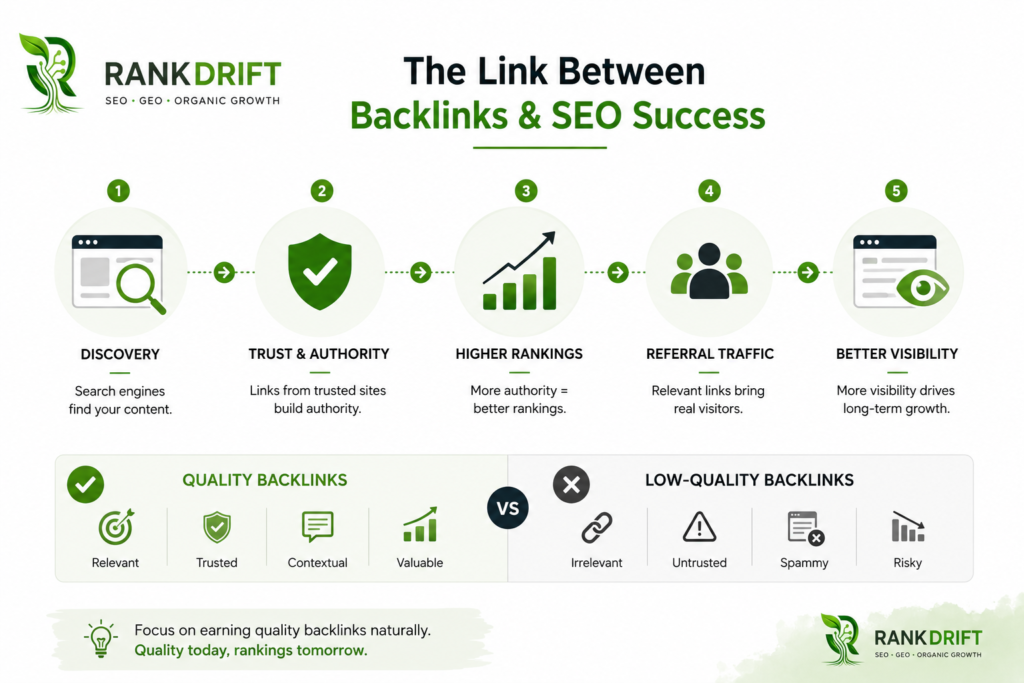
This makes backlinks useful in two different ways: discovery and authority signals.
Imagine a local accounting firm publishes a detailed guide about GST compliance. A respected business publication links to that guide because it provides useful supporting information. That link can send referral visitors, expose the company to a relevant audience, and provide Google with additional context about the page.
The important distinction is that the link exists because the content deserves to be referenced not because the website owner created it simply to manipulate rankings.
Backlinks vs. Other SEO Signals
SEO does not work through one ranking factor. Google says its systems use many signals and systems to determine which results are most relevant and useful.
| SEO element | Primary purpose | What it can contribute |
|---|---|---|
| Quality backlinks | External authority and discovery | Trust signals, referral traffic, discovery |
| Helpful content | Satisfy search intent | Relevance and user value |
| Technical SEO | Crawling and indexing | Search accessibility |
| Internal links | Connect website pages | Context and discoverability |
| Local SEO | Improve local presence | Visibility for location-based searches |
| User experience | Make pages usable | Better engagement and accessibility |
A strong SEO strategy combines these elements instead of expecting backlinks to solve every ranking problem.
What Makes a Backlink High Quality?
The number of backlinks pointing to your website is a poor way to judge the strength of your link profile.
A better question is: Would this link make sense to a real reader?
Google’s guidance says links can be valuable when they are well deserved, while its spam policies specifically target tactics designed primarily to manipulate rankings.
Several characteristics can make a backlink more useful.
1. Relevance
Relevance should come before volume.
For example, a backlink to a digital marketing agency from a reputable marketing publication is naturally relevant. A backlink from an unrelated website about industrial machinery may provide far less contextual value.
This does not mean every link must come from an identical industry. A business publication, local news website, professional association, supplier, event organizer, or complementary business can all be relevant depending on the context.
2. Editorial Placement
A link placed naturally within useful editorial content is generally more meaningful than a link buried in a random directory or sitewide footer.
Consider these two examples:
Natural:
A marketing publication discusses technical SEO and references your detailed website audit guide as supporting material.
Weak:
A website publishes hundreds of unrelated business links and adds your website to a generic “SEO websites” page.
The first exists because your content contributes something to the discussion. The second may exist primarily to create a link.
3. Authority and Trust
The website linking to you matters.
A link from an established publication, respected industry organization, or credible niche website can be more meaningful than dozens of links from websites with little genuine audience or editorial value.
However, avoid reducing link quality to a single third-party “domain authority” score. These metrics can help with prospecting, but they are not Google ranking scores.
4. Context
The surrounding content matters because it explains why the link exists.
If you publish a study about e-commerce conversion rates and another website references your research while discussing checkout optimization, the relationship is clear.
That contextual connection is much stronger than an isolated link with no meaningful explanation.
Quality Backlinks vs. Quantity: Which Approach Wins?
Businesses often make the mistake of treating link building like a numbers game.
They may set targets such as “get 50 backlinks this month” without considering where those links will come from or why another website would naturally reference their content.
A better approach is to evaluate link opportunities based on relevance, credibility, editorial value, and potential referral traffic.
| Approach | Short-term appearance | Long-term value | Risk |
|---|---|---|---|
| Buying large volumes of links | Fast increase in link count | Low | High |
| Random directory submissions | Easy to execute | Low | Medium |
| Automated link building | High volume | Very low | High |
| Relevant guest contribution | Moderate | Good | Low–Medium |
| Digital PR | Slower | High | Low |
| Original research/content assets | Slower | High | Low |
| Industry partnerships | Moderate | Good | Low |
| Helpful resource outreach | Moderate | Good | Low |
Google’s spam policies specifically identify buying or selling links for ranking purposes, excessive link exchanges, automated link creation, and low-quality directory links among examples of link spam.
That is why quality-first link building is a safer and more sustainable strategy than chasing raw backlink counts.
How to Earn Quality Backlinks Naturally
The strongest link-building campaigns usually start with something worth linking to.
If your website contains only service pages such as “SEO Services,” “Web Design,” and “Digital Marketing,” there may be limited reasons for other websites to reference those pages organically.
Content gives you more opportunities.
Create Original Data and Research
Original research is one of the strongest linkable assets because other writers can reference your findings.
For example, an Indian digital marketing agency could publish:
- A survey of small-business SEO challenges
- Local search behavior research
- Industry-specific conversion benchmarks
- A study of website speed across a particular sector
- An analysis of common technical SEO issues
When journalists, bloggers, and marketers use the findings, they have a reason to cite the original source.
Publish Useful Guides
Detailed guides can attract links when they solve a specific problem better than existing resources.
Instead of publishing a generic article titled “What Is SEO?”, create something more useful, such as:
“Technical SEO Checklist for Indian E-commerce Websites”
The more specific the resource, the easier it becomes to identify websites and communities that could genuinely benefit from referencing it.
Use Digital PR
Digital PR combines content, research, expert commentary, and media outreach.
For example, if RankDrift publishes original research about search visibility among Indian businesses, that research could become the basis for outreach to marketing publications, business websites, journalists, and relevant industry communities.
The objective is not simply to ask for a backlink. The objective is to give publishers something worth covering.
Build Industry Relationships
Not every useful backlink comes from a major publication.
Relevant links can also come from:
- Business associations
- Industry publications
- Local organizations
- Professional communities
- Event websites
- Business partners
- Suppliers
- Complementary businesses
For a local Indian business, a relevant local publication or industry association may be more valuable than an unrelated high-metric website.
Backlink Anchor Text Matters Too
Anchor text is the visible clickable text used for a link.
Google explains that descriptive anchor text helps users and Google understand the page being linked to.
For example:
Learn more about technical SEO for e-commerce websites.
This gives context about the destination.
Compare that with:
Click here to learn more.
The second option provides much less information.
However, that does not mean every backlink should use your exact target keyword. Repeatedly forcing keyword-rich anchor text can make a link profile look unnatural, particularly when links are being deliberately manipulated.
Natural anchor text can include:
| Anchor type | Example |
|---|---|
| Brand | RankDrift |
| Branded phrase | RankDrift SEO services |
| Descriptive | technical SEO guide |
| URL | rankdrift.agency |
| Natural phrase | this SEO research |
| Partial keyword | SEO strategy guide |
The goal is natural language and useful context rather than aggressive keyword optimization.
What Link Building Tactics Should You Avoid?
The fastest-looking strategy is not always the safest strategy.
Google’s current spam documentation explicitly lists several link-manipulation practices that can violate its policies, including buying or selling links for ranking purposes, excessive link exchanges, automated link creation, low-quality directories, and links embedded in low-value content primarily to manipulate rankings.
Avoid These Common Mistakes
Buying links solely to influence rankings:
Paid advertising and sponsorship are different from buying ranking credit. Google recommends qualifying appropriate commercial links with nofollow or sponsored attributes.
Using automated link-building tools:
Automation can create large numbers of irrelevant or suspicious links without genuine editorial value.
Excessive reciprocal linking:
Having a legitimate business relationship is fine. Creating large-scale “you link to me, I’ll link to you” arrangements primarily for ranking manipulation is not.
Low-quality guest posting:
Guest contributions can be useful when they provide genuine expertise to a relevant audience. They become problematic when articles are mass-produced primarily to obtain optimized links.
Chasing metrics instead of relevance:
A website with a high third-party authority score is not automatically a good link prospect.
A Practical Quality Backlink Checklist
Before pursuing a backlink, evaluate the opportunity using this simple process:
- Check relevance: Does the website’s audience overlap with your target customers?
- Review the website: Is it a genuine publication, organization, or business?
- Check the page context: Would your content genuinely improve the article?
- Look at existing content: Does the website publish useful, original material?
- Evaluate referral potential: Could the link send actual interested visitors?
- Choose natural anchor text: Avoid forcing exact-match keywords.
- Prioritize editorial value: Ask whether the link would exist without SEO manipulation.
- Document the opportunity: Track the website, page, contact, topic, and outcome.
- Monitor the link: Check periodically that valuable links remain live.
- Focus on relationships: Build repeat partnerships instead of one-off link transactions.
A useful internal benchmark is simple: if you would still want the link even if Google ignored it completely, the opportunity is probably worth considering.
Common Backlink Misconceptions
“More backlinks always mean better rankings.”
No. Google uses many ranking signals, and its systems evaluate pages individually using multiple systems.
A website with 500 irrelevant backlinks should not automatically outperform a competitor with 50 highly relevant editorial references.
“Every backlink must be dofollow.”
No. Links can serve useful discovery and referral purposes even when they do not pass ranking credit in the way SEOs traditionally expect.
The strategic objective should be earning legitimate references, not simply collecting a particular link attribute.
“Guest posting is dead.”
Not necessarily. Low-quality guest posting designed mainly to manufacture backlinks is the problem.
A genuinely useful expert contribution to a relevant publication can still provide exposure, referral traffic, relationships, and brand visibility.
“A high domain authority score guarantees a good backlink.”
No third-party metric guarantees ranking value.
Use these metrics as one part of prospect evaluation rather than treating them as Google’s own assessment.
How RankDrift Can Approach Link Building Strategically
For a business investing in SEO, link building should support the wider search strategy rather than operate as an isolated monthly activity.
RankDrift can approach backlink acquisition around the pages that matter most to the business: commercial landing pages, high-value guides, original research, local resources, and content that already demonstrates search demand.
The process should connect content → relevance → outreach → earned coverage → referral traffic → stronger website authority.
That also makes backlink reporting more useful. Instead of reporting only “40 new links,” evaluate which links were relevant, which pages they point to, whether they generated referral traffic, and whether the linked pages improved their visibility over time.
Frequently Asked Questions
Are backlinks still important for SEO in 2026?
Yes. Google continues to describe link analysis and PageRank as part of its ranking systems, while also emphasizing that Search uses many different signals and systems.
How many backlinks does a website need?
There is no universal number. The right quantity depends on your industry, competition, content, website authority, and the quality of opportunities available.
What is more important: backlinks or content?
Neither should be treated in isolation. Strong content gives people a reason to link to you, while quality backlinks can help discovery, authority signals, and referral traffic.
Can buying backlinks hurt SEO?
Buying or selling links specifically to manipulate search rankings can violate Google’s spam policies. Google recommends appropriately qualifying legitimate paid or sponsored links.
How can a small business earn backlinks?
Start with relevant content, original research, local resources, partnerships, industry publications, digital PR, and genuine outreach. A small business does not need thousands of links; it needs credible references that make sense for its market.
The Bottom Line
Backlinks still matter because the web itself is built around connections between pages. But modern link building is less about collecting links and more about earning credible references from relevant sources.
If your business is building SEO with RankDrift, treat every backlink as a business asset not a number in a monthly report. Create something worth referencing, build relationships around it, and prioritize links that would have value even without a search engine attached.