
Content marketing is one of the strongest ways to turn SEO from a traffic tactic into a long-term growth channel. Google says its systems prioritize helpful, reliable, people-first content rather than content created mainly to manipulate rankings.
For businesses competing in India, that distinction matters. Publishing more pages is not the goal; creating content that answers real customer questions, demonstrates expertise, earns links, and supports commercial decisions is what makes content marketing valuable for SEO.
Why Content Marketing Matters for SEO Success
SEO needs something useful to optimize. Technical improvements can help Google crawl and understand your website, while keywords help connect pages with search demand. But content gives your website the substance that can satisfy that demand.
The connection becomes clearer when you look at how successful content programs operate. Content Marketing Institute’s 2025 B2B research found that 87% of surveyed B2B marketers said content marketing helped create brand awareness, while 74% said it helped generate demand or leads.
That does not mean every blog post will generate leads. It means a well-planned content program can support multiple stages of the customer journey.
| SEO objective | Content marketing contribution |
|---|---|
| Target relevant searches | Creates pages around valuable topics |
| Build topical authority | Covers related questions and subtopics |
| Earn backlinks | Provides useful resources worth referencing |
| Improve engagement | Gives visitors answers and practical information |
| Support conversions | Educates prospects before they contact you |
| Build brand visibility | Gets your expertise in front of potential customers |
For RankDrift, the practical takeaway is simple: SEO and content marketing should not operate as separate activities. Your keyword research should influence your content plan, and your content performance should influence future SEO decisions.
Content Should Start With Search Intent, Not Keywords
One of the most common content mistakes is choosing a keyword and immediately writing an article around it.
A keyword tells you what someone searches. Search intent helps you understand why they are searching.
Consider a business selling SEO services. Someone searching for “what is SEO” is probably looking for education. Someone searching for “SEO agency in India” has a much stronger commercial intent. Treating both searches with the same type of page creates a mismatch.
Before producing content, identify what the searcher actually needs.
Informational intent
These searches usually involve learning or solving a problem.
Examples:
- What is technical SEO?
- How does keyword research work?
- How to improve website rankings
- Why is my website not appearing on Google?
These searches are generally suited to guides, explainers, tutorials, checklists, and educational articles.
Commercial and transactional intent
These searches indicate that the user is evaluating solutions or preparing to take action.
Examples:
- Best SEO agency for small business
- SEO services in India
- Local SEO company
- SEO audit services
These searches require stronger commercial pages, comparison content, service pages, case studies, and proof of expertise.
Google specifically advises publishers to create content for an existing or intended audience and asks whether readers will leave the page feeling they have learned enough to achieve their goal.
That is a useful test for every piece of content you publish.
Build Topic Clusters Instead of Publishing Random Blog Posts
A website with 50 unrelated blog posts may have less topical strength than a website with 20 strategically connected pages.
This is where topic clusters become useful.
Suppose your main service is SEO. Instead of publishing random articles such as “What Is SEO?” and “5 Marketing Tips,” build a connected content ecosystem around SEO.
A central page could target a broad topic such as SEO Services, supported by articles covering technical SEO, keyword research, content marketing, link building, local SEO, SEO audits, and measuring SEO performance.
The relationship might look like this:
SEO Services → Technical SEO → Website Speed → Core Web Vitals
SEO Services → Content Marketing → Keyword Research → Search Intent
SEO Services → Local SEO → Google Business Profile → Local Rankings
This structure gives users logical paths through your website while helping search engines understand how your pages relate to one another.
Content quantity vs. content depth
| Approach | Likely problem | Better alternative |
|---|---|---|
| Publish several unrelated posts | Weak topical connection | Build topic clusters |
| Target every possible keyword | Wasted resources | Prioritize business-relevant searches |
| Rewrite existing articles | Little original value | Add experience, data, examples |
| Publish only informational blogs | Limited commercial impact | Connect education to services |
| Focus only on volume | Quality can decline | Build a sustainable publishing system |
Content Marketing Institute’s research shows why strategy matters. Only 29% of B2B marketers surveyed rated their content strategy as extremely or very effective, while 58% considered it moderately effective. Among those with weaker results, 42% cited a lack of clear goals and 39% cited poor alignment with the customer journey.
The lesson is not to publish more. It is to publish with a purpose.
Create Content That Deserves to Rank
SEO content has changed significantly from the days when repeating a keyword across a page could be enough.
Google’s guidance emphasizes original information, substantial coverage, first-hand expertise, and content created primarily to help people. It also specifically warns against producing large amounts of content simply to attract search traffic.
That means your content needs something beyond basic information.
For example, an article about “How to Improve Local SEO” becomes more useful when it includes:
- Real optimization steps
- Examples of local search problems
- Practical Google Business Profile recommendations
- Internal linking opportunities
- Common mistakes
- Relevant data
- Original observations
- Clear next steps
The difference is information versus usefulness.
Anyone can summarize information already available online. Strong content adds interpretation, experience, evidence, examples, or a clearer way of solving the problem.
Use first-hand expertise wherever possible
If your business has worked with clients, analyzed websites, conducted SEO audits, or solved ranking problems, those experiences can strengthen your content.
Instead of writing:
“Page speed is important for SEO.”
Explain what you actually see during audits. For example, you might explain how large images, unnecessary scripts, or poorly configured hosting can affect user experience and how you prioritize fixes.
That type of detail makes an article more useful and more difficult to replicate.
Content Marketing Also Supports Link Building and Authority
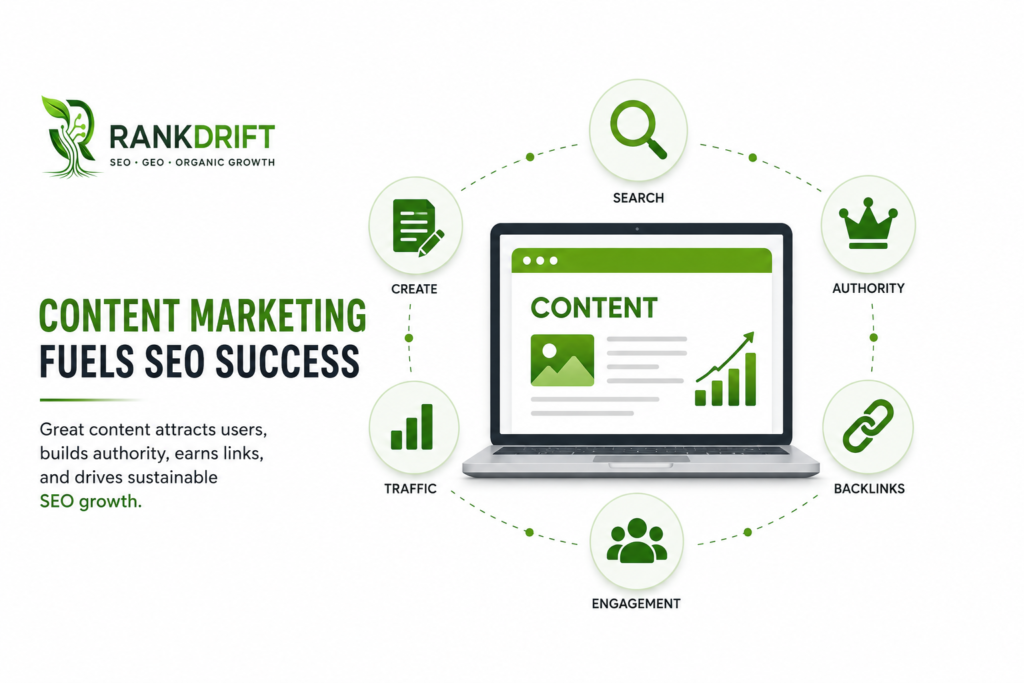
Backlinks remain an important part of SEO because they can help search engines understand relationships and reputation across the web. Content marketing gives businesses something other websites can actually reference.
A generic service page is rarely a natural link target.
A detailed research report, original industry study, useful checklist, calculator, benchmark, or comprehensive guide has a much better chance of attracting references.
For example, a digital marketing agency could create:
“SEO Performance Benchmark for Indian Small Businesses”
That resource could include anonymized findings, common technical problems, ranking patterns, and practical recommendations. Industry websites, blogs, consultants, and business publications may have reasons to reference it.
Content Marketing Institute’s research found that top-performing B2B content marketers were more likely to understand their audience, produce high-quality content, demonstrate industry expertise, align goals with business objectives, and measure performance effectively.
That combination is important because authority is not created simply by publishing articles. It develops when useful content consistently demonstrates expertise and earns attention.
Connect Content With the Customer Journey
A strong SEO content strategy should not stop at organic traffic.
Ask what happens after someone lands on the page.
Someone reading an article about technical SEO may eventually need a technical SEO audit. A visitor reading about local SEO may need help optimizing their Google Business Profile. Someone comparing SEO agencies may be ready to request a consultation.
Your content should make those next steps logical rather than forcing a sales pitch into every paragraph.
A practical content funnel can look like this:
| Customer stage | Content type | Example |
|---|---|---|
| Awareness | Educational blog | What Is SEO? |
| Problem awareness | Diagnostic guide | Why Is My Website Not Ranking? |
| Evaluation | Comparison / case study | SEO Agency vs. In-House SEO |
| Decision | Service page | SEO Services |
| Conversion | Audit / consultation | Free SEO Audit |
This approach also prevents a common problem: generating thousands of informational visits without generating meaningful business opportunities.
Content Marketing Institute reported that 49% of surveyed B2B marketers said content marketing helped generate sales or revenue, alongside its stronger awareness and demand-generation roles.
Common Content Marketing Mistakes That Hurt SEO
Publishing for volume
More articles do not automatically mean more organic traffic. Google explicitly warns against producing lots of content across many topics primarily because you hope some of it will rank.
A smaller collection of genuinely useful pages can be a stronger asset than hundreds of thin articles.
Writing for search engines instead of people
Keyword placement still matters, but forcing keywords into headings and paragraphs can make content unnatural.
Use the language your customers actually use. Cover related concepts naturally and focus on answering the underlying question.
Ignoring existing content
Businesses often create new articles while older pages decline.
Before producing another article, review existing content for outdated information, declining impressions, overlapping search intent, weak internal links, and missing sections.
Measuring only traffic
Traffic is useful, but it does not tell you whether content contributes to business growth.
Track metrics such as:
- Organic impressions
- Relevant clicks
- Keyword visibility
- Engagement
- Leads
- Assisted conversions
- Revenue where measurable
CMI found that 56% of B2B marketers surveyed struggle with attributing ROI to content efforts, while another 56% reported difficulty tracking customer journeys.
That makes measurement design an important part of the content strategy itself.
A Practical Content Marketing Checklist for SEO
Use this checklist before publishing your next SEO-focused article.
- Define the business goal. Decide whether the content is intended to build awareness, attract leads, support a service, or strengthen topical authority.
- Identify the search intent. Understand whether users want information, comparison, a solution, or a specific service.
- Choose the primary keyword. Select a relevant search term that matches both user intent and your business offering.
- Map supporting topics. Identify related questions and subtopics that should be covered naturally.
- Add original value. Include examples, data, experience, expert insight, screenshots, processes, or analysis where appropriate.
- Build internal links. Connect the article to relevant service pages and related resources.
- Optimize the page. Review the title, headings, URL, images, metadata, readability, and technical elements.
- Add a useful CTA. Give readers a logical next step based on the topic they just researched.
- Promote the content. Share valuable resources through appropriate social, email, community, and outreach channels.
- Measure and improve. Review Search Console and analytics data after publication and update the page when new information or opportunities emerge.
FAQs
How does content marketing help SEO?
Content marketing gives your website useful pages that can target relevant search queries, answer customer questions, build topical coverage, support internal linking, and create opportunities for backlinks.
How often should a business publish SEO content?
There is no universal publishing frequency. A sustainable schedule that allows your business to consistently produce useful, accurate content is better than publishing large quantities of low-value articles.
Does blogging improve Google rankings?
Blogging can support SEO when articles satisfy genuine search demand and provide useful information. Publishing blog posts alone does not guarantee rankings. Google emphasizes helpful, reliable, people-first content rather than content created primarily for search engines.
Should every blog post target a keyword?
Each article should have a clear topic and search intent, but you should not force a separate article for every keyword variation. Related searches can often be addressed effectively within one comprehensive page.
Can AI-generated content be used for SEO?
AI can assist with research, outlining, editing, and workflow efficiency, but the final content should provide genuine value and follow Google’s people-first principles. Google specifically cautions against using extensive automation to produce content across many topics primarily for search traffic.
The Real SEO Value of Content Marketing
Content marketing works best when it is treated as an SEO asset rather than a publishing task.
The goal is not to have the biggest blog. It is to build a useful library of content that answers important questions, demonstrates expertise, supports your services, earns visibility, and moves potential customers closer to a decision.
For businesses building organic growth, RankDrift can use this same principle: align content with search intent, technical SEO, internal linking, authority building, and measurable business outcomes.