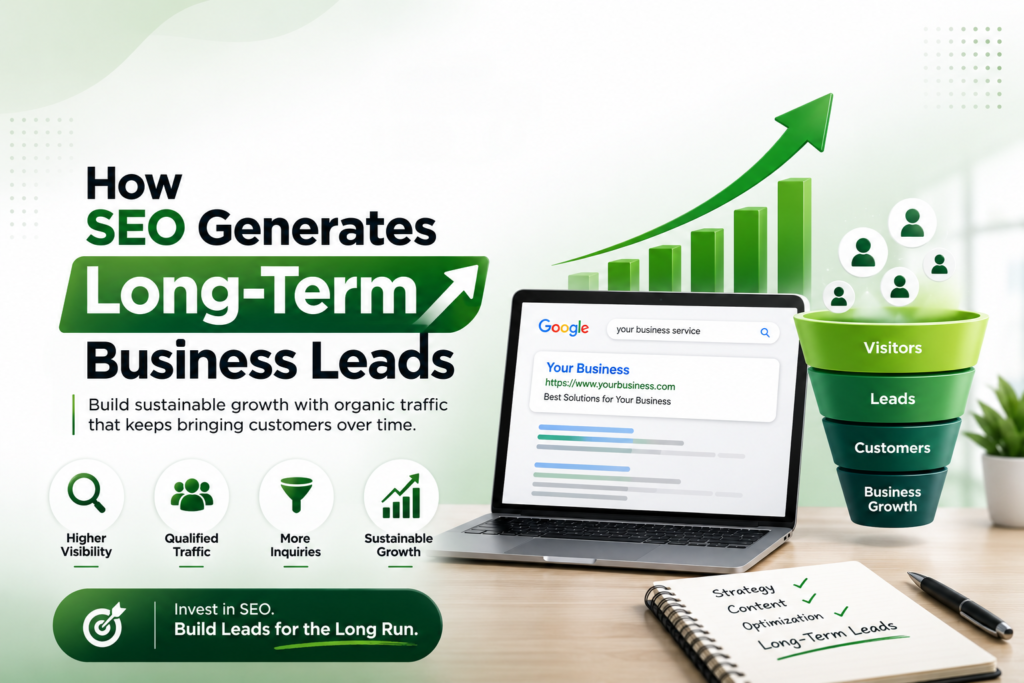
A paid campaign can stop producing leads the moment you stop paying for clicks. SEO works differently: a page that earns visibility in organic search can continue attracting potential customers months after it is published and optimized. That makes SEO less like a short-term promotion and more like an asset that can keep contributing to your pipeline.
Google explains that its search systems crawl, index, and rank pages based on relevance and many signals, with ranking systems operating across hundreds of billions of web pages and other content.
For businesses investing in sustainable growth, the real question is not simply whether SEO brings traffic. It is whether that traffic can consistently reach the right people, create enquiries, and contribute to revenue.
Why SEO Can Become a Long-Term Lead Channel
SEO generates long-term business leads because it targets people who are already searching for information, products, services, or solutions related to your business.
Consider the difference between these two approaches:
| Marketing approach | How people are reached | Lead potential | What happens when spending stops? |
|---|---|---|---|
| Paid Ads | Interrupts or captures demand through ads | Immediate | Traffic generally drops quickly |
| Social Media | Reaches audiences through feeds | Variable | Reach depends heavily on ongoing publishing |
| Email Marketing | Reaches an existing audience | Strong for nurturing | Database continues to have value |
| SEO | Captures existing search demand | High when intent is strong | Pages can continue attracting organic visitors |
SEO does not mean publishing an article and waiting for Google to send customers. The long-term advantage comes from building a collection of useful pages that target different stages of the buying journey.
Google states that its systems are designed to prioritize helpful, reliable, people-first content rather than content created primarily to manipulate rankings.
That changes how businesses should think about SEO.
Instead of asking:
“How many keywords can we rank for?”
Ask:
“Which searches indicate that someone could eventually become our customer?”
That shift is what turns SEO from a traffic project into a lead-generation strategy.
SEO Captures Customers at Different Stages of the Buying Journey
One of the biggest strengths of SEO is that you do not have to target only people who are ready to buy today.
A potential customer may start with a broad informational search, compare different solutions later, and eventually search for a specific service provider.
Your website can support each stage.
1. Informational searches
These are searches such as:
- How does SEO work?
- How can I improve website rankings?
- What is technical SEO?
- How much does SEO cost?
The visitor may not be ready to contact you yet. But a genuinely useful page gives your business an opportunity to introduce its expertise.
2. Commercial research searches
The person has moved closer to a purchase decision.
Examples include:
- Best SEO agency for small businesses
- SEO services for local businesses
- SEO agency pricing
- SEO vs Google Ads
At this stage, comparison pages, service guides, case studies, and detailed explanations can help move the visitor toward an enquiry.
3. Transactional searches
These searches show stronger commercial intent:
- SEO agency in Delhi
- SEO services for ecommerce
- Local SEO agency
- Hire SEO consultant
These pages should focus less on general education and more on demonstrating relevance, expertise, services, proof, and clear next steps.
Google notes that search results are influenced by factors such as relevance, language, location, and device, meaning the same query can produce different results for different users.
This is particularly important for Indian businesses targeting specific cities, industries, or customer segments.
A practical SEO funnel
| Search stage | Example query | Useful content | Lead potential |
|---|---|---|---|
| Awareness | What is SEO? | Educational guide | Low–Medium |
| Problem aware | Why is my website not ranking? | Troubleshooting article | Medium |
| Solution aware | How to improve Google rankings | Strategy guide | Medium–High |
| Commercial | Best SEO services for businesses | Comparison/service page | High |
| Transactional | SEO agency in Mumbai | Local/service landing page | Very High |
The goal is not to force every visitor into a sales call.
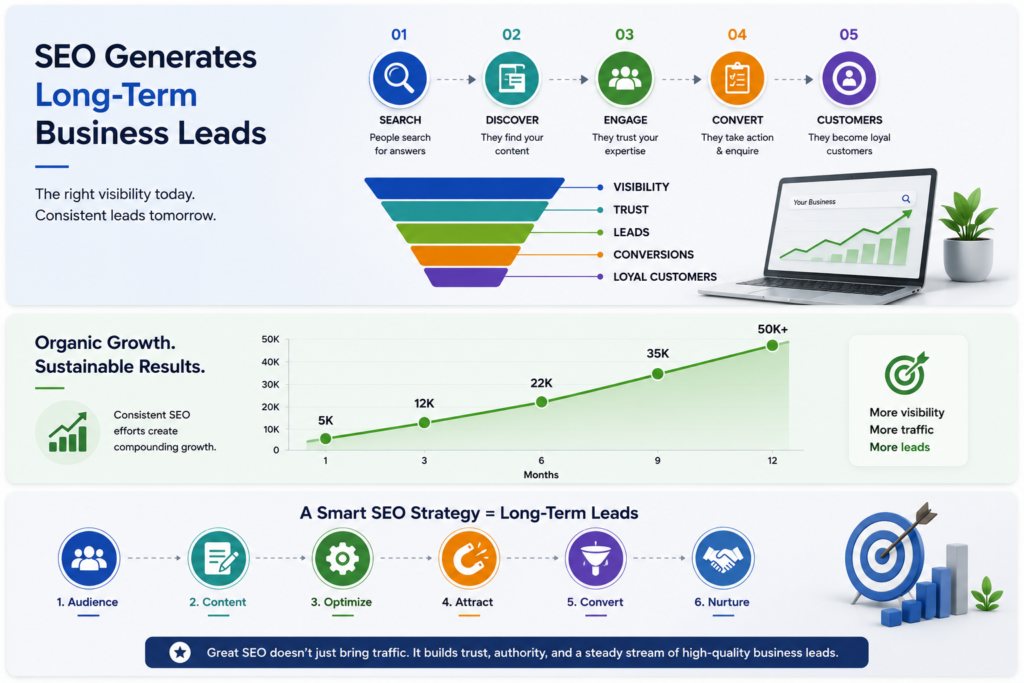
The goal is to build enough useful touchpoints that the right visitor can move naturally from search → information → trust → enquiry.
Why SEO Compounds Over Time
SEO has a compounding characteristic that many short-term marketing channels do not.
A useful page can attract impressions and clicks. That page can internally link to other relevant pages, support topical authority, generate enquiries, and strengthen the overall customer journey.
Then you publish another useful page.
Over time, the website becomes a larger search asset.
This does not mean every page will rank permanently. Google explicitly says that being indexed does not guarantee that a page will appear in search results, and its systems continually evaluate relevance and quality.
The better way to understand SEO compounding is through an illustrative example:
| Month | Useful ranking pages | Potential search entry points |
|---|---|---|
| 1 | 10 | 10 |
| 3 | 25 | 25 |
| 6 | 50 | 50 |
| 12 | 100 | 100+ |
These numbers are illustrative, not a guaranteed SEO forecast. Actual results depend on competition, search demand, content quality, technical SEO, authority, and many other variables.
The important principle is that your business can gradually build a larger collection of pages capable of attracting relevant searches.
That is why SEO should be measured as an asset-building process rather than only as a monthly traffic target.
The Most Important Part: Turning Organic Traffic Into Leads
Traffic alone does not pay the bills.
A website can receive thousands of visitors and generate very few enquiries if the pages are poorly aligned with user intent.
For lead generation, your SEO strategy needs to connect four elements:
Search intent → Relevant page → Trust → Conversion
For example, imagine a company providing accounting software.
Someone searching “what is accounting software” is probably not ready to request a demo.
Someone searching “best accounting software for small business” is much closer.
Someone searching “accounting software demo” has even stronger commercial intent.
The landing page should match that intent.
A common mistake is sending every organic visitor to the homepage. Instead, create landing pages that answer the specific problem behind the search.
Match the page to the intent
| Intent | Best page type | Primary CTA |
|---|---|---|
| Informational | Guide/blog | Read another guide |
| Problem-solving | Tutorial/resource | Get a consultation |
| Commercial | Comparison/service page | Request details |
| Transactional | Service/product page | Contact / Buy / Book |
| Local | Location/service page | Call / Enquire / Visit |
This is where SEO and conversion optimization need to work together.
Ranking brings the opportunity. The landing page must convert that opportunity.
Content Is the Engine Behind Long-Term SEO Leads
Businesses often treat content as a publishing schedule: four blogs per month, eight blogs per month, and so on.
That is not a strategy.
A stronger approach is to build topic clusters around commercial services.
For example, an SEO agency could create content around:
- SEO strategy
- Technical SEO
- Local SEO
- Keyword research
- Link building
- Google rankings
- SEO reporting
- SEO for small businesses
- SEO vs paid advertising
Each article can connect to a relevant service page.
Google recommends creating content that provides original information, substantial coverage, and value for users rather than content produced primarily to attract search traffic.
HubSpot’s 2025 blogging research also shows that organic search remains one of several distribution channels businesses use for blog content, with 36% of surveyed businesses with blogs reporting organic search as a distribution source.
The takeaway is simple: content should support the commercial structure of your website.
A blog should not exist in isolation.
It should help a potential customer understand a problem, evaluate solutions, trust your expertise, and eventually reach a relevant service or product page.
Technical SEO Protects Your Lead Pipeline
You can create excellent content and still struggle to generate leads if search engines cannot properly crawl, understand, or serve your pages.
Google describes Search in three major stages: crawling, indexing, and serving results. Not every page makes it through every stage.
Common technical issues include:
- Important pages blocked from crawling
- Incorrect
noindexdirectives - Broken internal links
- Poor website structure
- Duplicate or thin pages
- Slow or unstable experiences
- Poor mobile usability
- Incorrect canonicalization
- Weak internal linking
For a growing business, technical SEO should therefore be treated as infrastructure.
Technical SEO vs content SEO
| Area | Primary job | Lead-generation impact |
|---|---|---|
| Technical SEO | Make pages accessible and understandable | Protects search visibility |
| On-page SEO | Improve relevance and clarity | Helps attract the right searches |
| Content | Answer customer questions | Builds awareness and trust |
| Internal linking | Connect related pages | Moves users toward commercial pages |
| Conversion optimization | Turn visitors into enquiries | Converts traffic into leads |
The strongest SEO programs work on these areas together rather than treating them as separate projects.
SEO Leads Are Not Automatically High Quality
Another misconception is that more organic traffic automatically means more customers.
It does not.
Suppose Website A receives 20,000 monthly organic visits but most visitors are researching unrelated topics.
Website B receives 3,000 monthly organic visits, but those visitors are searching for specific services and pricing information.
Website B may generate substantially more qualified leads.
This is why RankDrift recommends evaluating SEO beyond traffic volume.
Track metrics such as:
- Organic clicks
- Non-branded impressions
- Commercial keyword visibility
- Landing-page conversions
- Form submissions
- Phone calls
- Consultation requests
- Qualified leads
- Lead-to-customer rate
- Revenue influenced by organic search
Google Search Console can help businesses understand how pages perform in Google Search, while analytics and CRM data can connect organic acquisition to actual business outcomes.
The objective is not simply “more visitors.”
It is “more valuable visitors.”
Common SEO Mistakes That Limit Long-Term Leads
Publishing content without search intent
A keyword may have significant search volume but little commercial value for your business.
Better approach: Evaluate intent before creating the page.
Chasing only high-volume keywords
Large keywords often attract intense competition.
Better approach: Build a mix of commercial, local, long-tail, and supporting informational queries.
Treating rankings as the final KPI
A ranking is useful only when it creates visibility, clicks, engagement, or conversions.
Better approach: Connect rankings to organic traffic and lead data.
Ignoring existing pages
Businesses often publish new content while older pages lose relevance.
Better approach: Review important pages regularly and improve outdated information, internal links, titles, and conversion paths.
Creating content only for Google
Google’s guidance specifically emphasizes people-first content.
Better approach: Write for the customer first, then optimize the page technically and semantically.
A Practical SEO Lead-Generation Checklist
Use this process to turn SEO into a measurable lead channel:
- Identify your highest-value services.
Start with what actually generates revenue. - Map search intent to those services.
Separate informational, commercial, local, and transactional searches. - Build dedicated landing pages.
Do not rely on one generic homepage. - Create supporting content.
Answer the questions customers ask before contacting you. - Strengthen internal links.
Connect informational articles to relevant commercial pages. - Fix technical barriers.
Check crawling, indexing, redirects, canonical tags, mobile usability, and broken links. - Improve conversion paths.
Make enquiry forms, calls, consultations, and other CTAs easy to find. - Track qualified leads.
Do not stop at impressions and rankings. - Refresh valuable pages.
Improve content based on performance and changing search intent. - Review SEO with business data.
Compare organic leads, conversion rates, customer value, and revenue not just keyword positions.
FAQ
How long does SEO take to generate leads?
There is no universal timeline. Results depend on website authority, competition, technical condition, content quality, search demand, and the starting point of the campaign. SEO should be evaluated over a sustained period rather than expecting guaranteed results within a fixed number of weeks.
Does SEO generate better leads than paid advertising?
Neither channel automatically produces better leads. SEO can be particularly effective when users are actively searching for a solution, while paid advertising can provide faster visibility and more control over targeting and budget. A strong strategy can use both.
Can small businesses generate leads through SEO?
Yes. Small businesses can focus on specific services, locations, customer problems, and long-tail searches where relevance matters more than competing broadly for every high-volume keyword.
Should businesses focus on traffic or leads?
Leads should be closer to the business goal. Traffic is useful as a diagnostic metric, but qualified enquiries, conversion rates, customers, and revenue provide a clearer picture of SEO’s commercial value.
Can old SEO content continue generating leads?
Yes, if the content remains useful, relevant, technically accessible, and competitive in search results. Google does not guarantee continued rankings, so important pages should be reviewed and improved as search behavior and competition change.
The Long-Term Value of SEO
SEO generates long-term business leads when it is built around customer intent, useful content, technical accessibility, strong landing pages, and measurable conversions.
The businesses that benefit most are not necessarily the ones publishing the most content. They are the ones building a search presence around the questions and problems their customers actually have.
For businesses in India looking to build sustainable organic growth, RankDrift can approach SEO as a lead-generation system not simply a ranking exercise. The goal is to build visibility that continues creating opportunities while the underlying website becomes a stronger business asset.