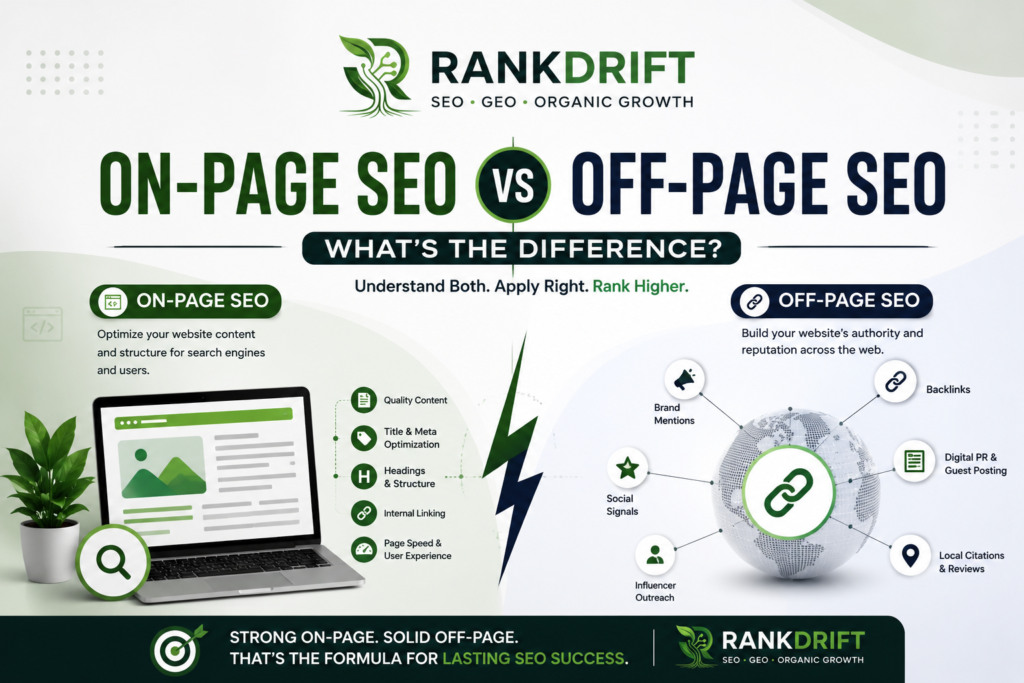
If your website is not ranking, the problem may not be just your content or backlinks. On-page SEO vs off-page SEO is not an either-or decision—one improves what happens on your website, while the other helps build authority and credibility around it.
Google says its ranking systems use many signals to understand individual pages and determine which results are most relevant and useful for a search. For a business competing in India, understanding where on-page work ends and off-page SEO begins can help you invest your SEO budget more intelligently.
Why On-Page and Off-Page SEO Both Matter
Think of your website as a business location.
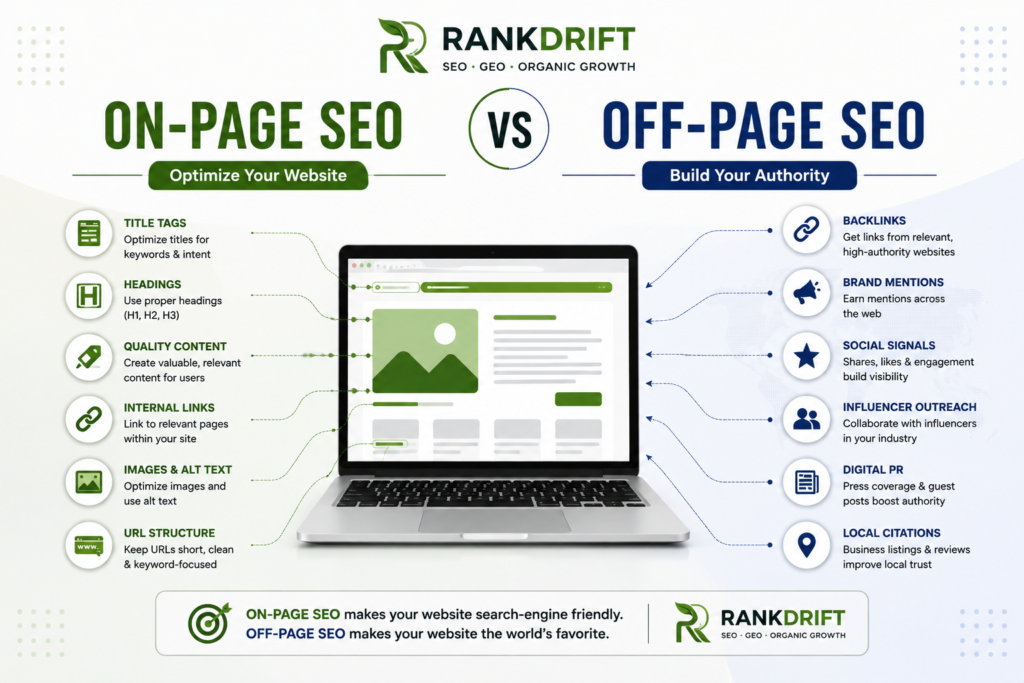
On-page SEO is everything you improve inside that location: your content, page structure, headings, internal links, images, keywords, and user experience.
Off-page SEO is what happens outside it: links from other websites, brand mentions, digital PR, reviews, and other signals that can strengthen your site’s reputation.
Google’s own documentation explains that links help Google find new pages and understand the relevance of pages, while its Search Essentials emphasize helpful, reliable, people-first content and using words that searchers would actually use.
The distinction is simple:
| SEO Area | Main Focus | Examples | Primary Goal |
|---|---|---|---|
| On-Page SEO | Your website | Content, titles, headings, internal links | Relevance and usability |
| Off-Page SEO | Outside your website | Backlinks, PR, mentions | Authority and reputation |
| Technical SEO | Website infrastructure | Crawlability, indexing, performance | Accessibility for search engines |
| Local SEO | Local visibility | Google Business Profile, reviews, local signals | Local customers |
For most businesses, the strongest strategy combines these areas instead of treating them as separate campaigns.
What Is On-Page SEO?
On-page SEO refers to improvements made directly to the pages of your website to help search engines understand the topic and help users find useful information.
Google’s SEO Starter Guide specifically recommends creating content that is useful, unique, readable, well organized, up to date, and written for people first.
1. Keyword and Search Intent Alignment
Keywords still matter, but simply inserting a phrase repeatedly is not a strategy.
Suppose you operate an accounting firm in Delhi. Someone searching for:
“GST registration consultant in Delhi”
has a different intent from someone searching for:
“how to register for GST”
The first may be looking for a service provider. The second may be looking for information.
Your page should match that intent.
| Search Intent | Example Query | Suitable Page |
|---|---|---|
| Informational | What is GST registration? | Guide/blog |
| Commercial | Best GST consultant in Delhi | Comparison/service content |
| Transactional | GST registration service Delhi | Service page |
| Navigational | RankDrift SEO services | Brand/service page |
This is why creating one generic page for every keyword variation often produces weaker results than building focused pages around real customer needs.
2. Titles, Headings and Content Structure
Your title tag, H1, headings and body content should make the subject of the page obvious.
Google notes that search systems can understand relationships between words and concepts without requiring every exact keyword variation to appear on the page.
That means you should write naturally rather than forcing the target keyword into every paragraph.
A good service page might use:
- H1: Digital Marketing Agency in Delhi
- H2: Digital Marketing Services We Offer
- H2: How Our Process Works
- H2: Why Businesses Choose Us
- H2: Frequently Asked Questions
The structure helps both users and search engines understand the page.
3. Internal Linking
Internal links connect related pages on your own website.
For example, a page about SEO services could naturally link to:
- Keyword research
- Technical SEO
- Local SEO
- Link building
- SEO audit
Google states that links can connect users and search engines to other relevant resources, and descriptive anchor text helps explain what the linked page contains.
This is particularly important for larger websites where valuable pages can otherwise become difficult to reach.
4. Content Quality
Publishing 50 short articles is not automatically better than publishing 10 genuinely useful resources.
Google’s current guidance emphasizes original, helpful, reliable, people-first content rather than content created primarily to manipulate rankings.
For a business, this means your content should answer questions customers actually have, demonstrate experience, explain processes clearly and provide information that helps someone make a decision.
What Is Off-Page SEO?
Off-page SEO focuses on signals and activities that happen away from your website but can influence how your brand and website are perceived.
The most commonly discussed element is link building.
Google’s ranking documentation says its link analysis systems use links to understand how pages relate to one another, and PageRank remains part of Google’s core ranking systems.
But that does not mean every backlink is valuable.
Quality Matters More Than Quantity
Imagine two websites.
Website A has 500 links from unrelated, low-quality websites.
Website B has 20 relevant links from respected publications and industry websites.
The second profile may be far more meaningful because the links are contextually relevant and earned for legitimate reasons.
Google explicitly warns against link spam—links created primarily to manipulate search rankings.
Google has also explained that its SpamBrain systems can detect unnatural links, including sites buying links and sites created to pass outgoing links.
What Can Off-Page SEO Include?
A legitimate off-page strategy can involve:
- Digital PR
- Industry publications
- Relevant guest contributions
- Expert interviews
- Business citations
- Partnerships
- Brand mentions
- Useful resource links
- Original research that earns references
- Community and industry participation
The objective should not be “get as many links as possible.”
The objective should be build a reputation strong enough that relevant websites have a reason to reference your business.
On-Page SEO vs Off-Page SEO: The Real Difference
The easiest way to understand the difference is to look at what each activity controls.
| Factor | On-Page SEO | Off-Page SEO |
|---|---|---|
| Content | Directly controlled | Indirectly influenced |
| Keywords | Directly optimized | Not directly controlled |
| Page titles | Directly controlled | Not applicable |
| Internal links | Directly controlled | Not applicable |
| Backlinks | Cannot fully control | Main focus |
| Brand mentions | Limited control | Important signal |
| Digital PR | Supporting role | Major role |
| User experience | Directly controlled | Indirect effect |
| Website authority | Supports it | Strong focus |
| Risk | Over-optimization | Link spam |
This distinction changes how you should allocate resources.
If your service page has weak content, earning 100 backlinks to it may not solve the underlying problem.
If your website has excellent content but nobody in your industry references it, authority may become the bottleneck.
Which Is More Important: On-Page or Off-Page SEO?
Neither is universally more important. The right priority depends on what is preventing your website from competing.
For a new website with poorly structured pages, start with on-page and technical foundations.
For a website with strong content that consistently loses competitive searches to established domains, authority-building may deserve more attention.
A practical prioritization model looks like this:
| Website Situation | First Priority | Second Priority |
|---|---|---|
| New website | Technical + On-page | Off-page |
| Poor-quality content | Content + On-page | Authority |
| Strong content, weak authority | Off-page | Content expansion |
| Local business | Local + On-page | Reviews/citations |
| Established website | Technical/content audit | Authority growth |
| Competitive industry | Content quality | Relevant authority |
This approach prevents businesses from spending money on tactics before fixing the foundation.
How On-Page and Off-Page SEO Work Together
The strongest SEO campaigns connect both sides.
Imagine a RankDrift client creates an in-depth guide targeting a valuable commercial topic.
First, the team improves the page:
- Understands the search intent.
- Builds a clear content structure.
- Optimizes the title and headings.
- Adds relevant internal links.
- Improves supporting content.
- Makes the page easy to navigate.
That is the on-page layer.
Then the business promotes the resource through legitimate channels:
- Industry outreach.
- Digital PR.
- Expert contributions.
- Relevant partnerships.
- Original data or research.
- Brand promotion.
That creates the off-page layer.
The two efforts reinforce each other because the authority-building campaign has a useful destination to point people toward.
Google also emphasizes that links can help users and search engines connect related resources, making useful linking part of a broader content ecosystem rather than simply a ranking tactic.
Common Mistakes Businesses Make
1. Treating SEO as a Backlink Campaign
Buying or generating large numbers of links without improving the website can create a fragile strategy.
Google’s spam policies specifically identify links created primarily to manipulate rankings as link spam.
2. Stuffing Keywords Into Pages
Repeating the same keyword dozens of times does not make a page more relevant.
Google defines keyword stuffing as filling a page with keywords or numbers in an attempt to manipulate rankings, including unnatural repetition.
Write for the searcher’s question first.
3. Ignoring Internal Links
Businesses often spend money acquiring external links while leaving important pages buried several clicks deep.
A well-planned internal linking structure helps users navigate and gives search engines additional paths to discover relevant pages.
4. Publishing Content Without Search Intent
A page can be well written and still target the wrong type of search.
Before creating content, ask:
What does the person searching this query actually want to accomplish?
5. Measuring Only Rankings
A ranking improvement is useful, but business outcomes matter more.
Track:
- Organic clicks
- Impressions
- Qualified traffic
- Leads
- Calls
- Form submissions
- Revenue where attribution is available
Google Search Console is specifically designed to help website owners understand their performance in Google Search.
Practical SEO Checklist for Your Business
Use this checklist before increasing your SEO budget.
On-Page SEO
- Identify the search intent behind your primary keywords.
- Make sure each important page has a clear purpose.
- Write unique title tags and H1 headings.
- Organize content with logical H2 and H3 sections.
- Add relevant internal links.
- Remove outdated or thin content where appropriate.
- Improve pages that receive impressions but few clicks.
- Add useful original information instead of rewriting competitors.
Off-Page SEO
- Audit your existing backlink profile.
- Identify relevant industry websites and publications.
- Create resources worth referencing.
- Build relationships with legitimate publishers and partners.
- Use digital PR where it makes sense for your business.
- Avoid bulk link packages and obvious link schemes.
Measurement
- Connect Google Search Console.
- Track important landing pages.
- Monitor organic conversions.
- Compare branded and non-branded search performance.
- Review backlink growth and quality.
- Evaluate SEO based on qualified business outcomes, not rankings alone.
FAQs
What is the difference between on-page SEO and off-page SEO?
On-page SEO improves elements directly on your website, such as content, headings, keywords, internal links and page structure. Off-page SEO focuses on external signals such as backlinks, digital PR, brand mentions and industry relationships.
Is on-page SEO more important than backlinks?
Not necessarily. On-page SEO creates a strong and relevant destination, while quality off-page signals can help build authority. The right balance depends on your website’s current weaknesses and competitive environment.
How many backlinks does a website need?
There is no universal number. A relevant, authoritative backlink can be more useful than many low-quality links. Google specifically warns against links created primarily to manipulate rankings.
Can a website rank without backlinks?
Yes. Google can discover and rank pages through many signals, and not every page requires a large backlink profile. However, competitive searches may be harder to win without strong authority signals.
Should a small business invest in on-page or off-page SEO first?
Start with the foundation: technical accessibility, useful content, search intent, page structure and internal linking. Once those elements are strong, invest in relevant authority-building activities that support your most important pages.
The Best SEO Strategy Uses Both
On-page SEO answers “Is this page useful and relevant to the search?”
Off-page SEO helps answer “Does this website have enough authority and reputation to compete?”
Treating either one as a complete SEO strategy leaves a gap. Build the website properly first, then earn the authority that helps the strongest pages compete. For businesses that want sustainable organic growth, RankDrift can use both sides of SEO as part of a strategy focused on visibility, qualified traffic and measurable business results.