Google accounted for 91.27% of the worldwide search engine market share in June 2026, according to StatCounter. For a business that wants to be found online, search visibility is therefore not a minor marketing advantage; it can determine how easily potential customers discover your products, services, and expertise.
Search Engine Optimization (SEO) is the process of improving your website so search engines can understand its content and users can find it through relevant searches. Google describes SEO in similar terms: helping search engines understand your content while helping users find your site through Search.
For a business owner, the goal isn’t simply to rank for more keywords. The goal is to appear when the right customer searches for something your business can genuinely solve.
Why Search Engine Optimization Matters for Businesses
A website can look professional, load products, list services, and still generate very little organic traffic if search engines cannot properly discover, understand, or evaluate its pages.
Google’s Search Essentials identify technical requirements, spam policies, and key best practices that help websites become eligible to appear in Search. Meeting those requirements does not guarantee rankings, but they establish the foundation on which SEO work is built.
For businesses in India, SEO can be particularly valuable because customers increasingly research businesses online before contacting them. A local service provider, ecommerce company, B2B manufacturer, SaaS company, or professional service firm can use SEO to capture demand at different stages of the buying journey.
SEO vs Paid Search
SEO and paid advertising can work together, but they operate differently.
| SEO | Paid Search |
|---|---|
| Earns organic visibility | Buys ad placement |
| Can continue generating traffic after optimization | Traffic generally stops when campaigns stop |
| Requires ongoing content and technical work | Requires ongoing advertising budget |
| Builds long-term search visibility | Useful for immediate campaign visibility |
| Results can take time | Can generate visibility quickly |
Neither approach is automatically better. The right mix depends on your goals, competition, budget, and customer journey.
How Search Engines Actually Work
Before optimizing a website, you need to understand the basic process behind Search.
Google describes three major stages: crawling, indexing, and serving results. Automated crawlers discover pages, Google processes and stores information about them in its index, and ranking systems then determine which results are most relevant to a particular search.
1. Crawling
Search engines use automated programs called crawlers to discover webpages.
Google explains that the vast majority of pages in its results are discovered automatically as crawlers explore the web.
Your first SEO responsibility is therefore simple: make your important pages accessible to search engines.
Check:
- Can Googlebot access the page?
- Does the URL return a successful response?
- Are important pages linked internally?
- Is your sitemap configured correctly?
- Are you accidentally blocking important pages with robots.txt or other directives?
Google’s technical requirements state that a page needs accessible content, a successful HTTP status, and must not block Googlebot to be eligible for indexing.
2. Indexing
After crawling a page, Google analyzes its content and decides whether and how it should be included in its index.
This is where your page structure becomes important.
Clear headings, descriptive URLs, useful content, internal links, images with appropriate context, and structured data where relevant can help search engines understand what a page is about.
A sitemap can help Google discover new or updated URLs, but Google explicitly states that submitting a sitemap does not guarantee indexing or improve rankings by itself.
3. Ranking and Search Results
When someone searches, Google’s ranking systems evaluate many signals to determine which results are most relevant and useful.
Google says its systems consider signals across hundreds of billions of webpages and other content in its index. Ranking happens primarily at the page level, although site-wide signals and classifiers also contribute to Google’s understanding of websites.
This is why SEO isn’t about finding one secret ranking factor.
It is about making your website consistently useful, accessible, relevant, trustworthy, and technically sound.
The Four Core Areas of SEO
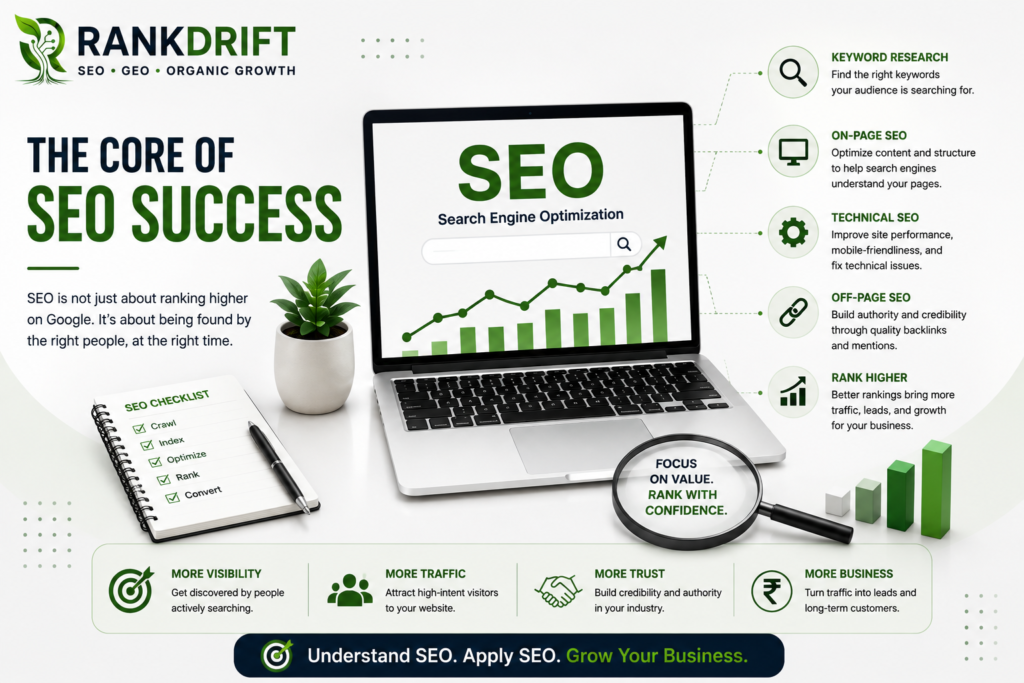
A beginner-friendly SEO strategy can be divided into four connected areas.
| SEO Area | Main Purpose | Examples |
|---|---|---|
| Keyword & Search Intent | Understand what customers want | Keyword research, intent analysis |
| On-Page SEO | Make pages relevant and understandable | Titles, headings, content, internal links |
| Technical SEO | Help search engines access and process your site | Crawling, indexing, speed, mobile usability |
| Off-Page SEO | Build authority and credibility | Backlinks, digital PR, brand mentions |
These areas should not be treated as isolated tasks.
For example, excellent content won’t perform well if search engines cannot crawl it. Likewise, technically perfect pages won’t generate customers if they target irrelevant searches.
1. Keyword Research: Start With What Customers Search
Keyword research is the foundation of effective Search Engine Optimization.
But beginners often make one mistake: choosing keywords based only on search volume.
A keyword is valuable when it connects search demand with business intent.
For example, an SEO agency might target:
- “SEO”
- “SEO services”
- “SEO agency in Delhi”
- “SEO agency for small businesses”
- “technical SEO audit”
These searches don’t have identical intent.
Someone searching “what is SEO” is probably learning. Someone searching “SEO agency in Delhi” may already be evaluating providers.
Think Beyond Exact Keywords
Google’s own SEO Starter Guide recommends anticipating the different terms users might search for and explains that Google’s language-matching systems can understand how pages relate to many queries without requiring every exact variation to appear on the page.
That means you shouldn’t force a keyword into every paragraph.
Instead:
- Identify the main topic.
- Understand the searcher’s intent.
- Identify related questions and subtopics.
- Create the most useful page for that intent.
- Use relevant terminology naturally.
2. On-Page SEO: Make Every Page Understandable
On-page SEO is about improving the content and structure of individual pages.
Important elements include:
Title Tag
Your title should accurately describe the page and give users a reason to click.
Headings
Use H1, H2, and H3 headings to organize information logically.
Content
Write for the person who needs the answer not simply for a search engine.
Internal Links
Connect related pages so users and search engines can navigate your website more easily.
URLs
Keep URLs descriptive and understandable.
For example:
Better:
/local-seo-services/
Less useful:
/page?id=2847
Google specifically recommends logically organized URLs that are understandable to humans.
3. Technical SEO: Build a Website Search Engines Can Access
Technical SEO sounds complicated, but the fundamentals are practical.
Start with these areas:
- Crawlability
- Indexability
- Mobile experience
- Page performance
- HTTPS
- XML sitemap
- Canonical URLs
- Redirects
- Broken links
- Structured data where appropriate
Google’s technical requirements provide a useful starting point: Googlebot must not be blocked, the page should work successfully, and the page needs indexable content.
A Simple Technical SEO Priority System
| Priority | Check | Why |
|---|---|---|
| High | Important pages indexable | Pages cannot rank if they aren’t eligible for indexing |
| High | Mobile usability | Many users access websites on mobile devices |
| High | Broken/incorrect URLs | Can prevent users and crawlers reaching content |
| Medium | Internal linking | Helps discovery and navigation |
| Medium | Structured data | Can help Google understand eligible content |
| Ongoing | Performance monitoring | Helps maintain a strong page experience |
Don’t start with advanced technical changes if basic accessibility problems remain unresolved
4. Content: Create Something Worth Ranking
Content is where many SEO campaigns succeed or fail.
Google’s guidance says its automated ranking systems are designed to prioritize helpful, reliable, people-first information rather than content created primarily to manipulate rankings.
That changes how you should approach blogging.
Don’t ask:
“How many articles can we publish this month?”
Ask:
“Which customer questions can our business answer better than the alternatives?”
A strong business article should provide useful information, practical examples, original analysis, or first-hand expertise.
Weak Content vs Useful Content
| Weak Approach | Better Approach |
|---|---|
| Rewrites competitors | Adds original insight |
| Repeats keywords | Answers search intent |
| Written only for traffic | Written for a defined audience |
| Generic examples | Relevant business examples |
| Created in bulk without review | Edited for accuracy and usefulness |
Google also explicitly says there is no preferred word count that automatically helps a page rank.
So don’t stretch a 700-word topic into 2,000 words just to hit a target.
Make it as comprehensive as the subject requires.
Off-Page SEO: Build Authority Beyond Your Website
Search visibility isn’t determined entirely by what happens on your own website.
Relevant, trustworthy links from other websites can help search engines understand that your content or business has authority.
But link building should focus on quality and relevance, not volume.
Better Link-Building Approaches
- Publish original research
- Create useful industry resources
- Earn mentions from relevant publications
- Build relationships with legitimate industry websites
- Contribute expert insights where appropriate
- Promote genuinely useful content
Avoid shortcuts such as buying large quantities of low-quality links or participating in manipulative link schemes.
SEO works best when authority is earned rather than artificially manufactured.
SEO for Local and Indian Businesses
If your business serves a specific city, region, or service area, Local SEO should be part of your strategy.
For example:
- “digital marketing agency in Mumbai”
- “dentist in Gurgaon”
- “best interior designer in Pune”
- “AC repair in Noida”
A strong local SEO strategy can include:
- Google Business Profile optimization
- Location-specific landing pages
- Local keyword research
- Customer reviews
- Consistent business information
- Local citations
- Relevant local links
For a small business, this can be more valuable than trying to rank nationally for an extremely competitive keyword.
Common SEO Mistakes Beginners Should Avoid
SEO becomes unnecessarily difficult when businesses focus on shortcuts.
Mistake 1: Expecting Immediate Results
SEO can take time because search engines need to crawl, process, and evaluate changes. Google states that crawling and indexing depend on many factors and that it cannot guarantee when a particular URL will be crawled or indexed.
Mistake 2: Stuffing Keywords
Repeating the same phrase unnaturally can make content difficult to read and does not create a better experience.
Mistake 3: Copying Competitors
Google’s SEO guidance recommends creating unique content rather than simply rehashing what others have published.
Mistake 4: Ignoring Existing Pages
Sometimes the fastest opportunity is improving pages you already have rather than continuously publishing new ones.
Mistake 5: Measuring Only Rankings
A ranking increase is useful, but business outcomes matter more.
Track:
- Organic traffic
- Qualified leads
- Phone calls
- Form submissions
- Sales
- Revenue
- Conversion rate
A Practical SEO Plan for Beginners
You don’t need to rebuild your entire website on day one.
Use this sequence.
Step 1: Audit Your Website
Check indexing, technical issues, page speed, mobile usability, broken links, existing content, and organic performance.
Step 2: Identify Business Priorities
List your most profitable products or services.
Step 3: Research Search Intent
Find the questions, problems, and commercial searches associated with those services.
Step 4: Optimize Existing Pages
Improve titles, headings, content, internal links, URLs, images, and calls to action.
Step 5: Create Supporting Content
Build useful articles around customer questions and related topics.
Step 6: Strengthen Authority
Earn relevant mentions, links, reviews, and industry recognition.
Step 7: Monitor Search Performance
Use Google Search Console to identify impressions, clicks, queries, indexing issues, and pages gaining or losing visibility. Google specifically recommends Search Console as a tool for understanding how websites perform in Google Search.
Step 8: Improve Based on Data
SEO should operate as a cycle:
Research → Optimize → Publish → Measure → Improve
Not:
Publish → Wait → Hope
Frequently Asked Questions
What is Search Engine Optimization in simple terms?
Search Engine Optimization is the process of improving a website so search engines can understand its content and users can find relevant pages through organic search results.
How long does SEO take to work?
There is no universal timeline. Results depend on competition, website authority, technical condition, content quality, search intent, and the changes being implemented. Google does not guarantee when individual URLs will be crawled or indexed.
Is SEO still useful in 2026?
Yes. Google remains the dominant search engine globally, accounting for 91.27% of worldwide search engine market share in June 2026 according to StatCounter. Businesses therefore still have substantial opportunity to reach customers through organic search.
Do I need an SEO agency?
Not necessarily. Small businesses can handle many fundamentals internally. However, an experienced SEO team can be valuable when your website has technical problems, operates in a competitive market, needs scalable content, or requires advanced strategy and analysis.
What should I learn first as an SEO beginner?
Start with search intent, keyword research, on-page optimization, crawling and indexing, technical SEO fundamentals, content quality, internal linking, and performance measurement. Once these foundations are understood, move into advanced areas such as structured data, digital PR, international SEO, and programmatic strategies.
Start With the Fundamentals, Then Build
Search Engine Optimization is not a collection of tricks designed to manipulate Google. It is a structured process for making your website easier to discover, understand, evaluate, and use.
For a business, the strongest starting point is simple: identify what your customers search for, build genuinely useful pages around those needs, make sure search engines can access them, and measure whether that visibility produces business results.
That is the foundation on which RankDrift can build a sustainable SEO strategy one focused not just on rankings, but on qualified traffic, visibility, and growth.